(302) 262 8484
Why a Failed Video Game Became Slack: The $27 Billion Pivot Story

How a Failed Video Game Became Slack: The Glitch Origin Story
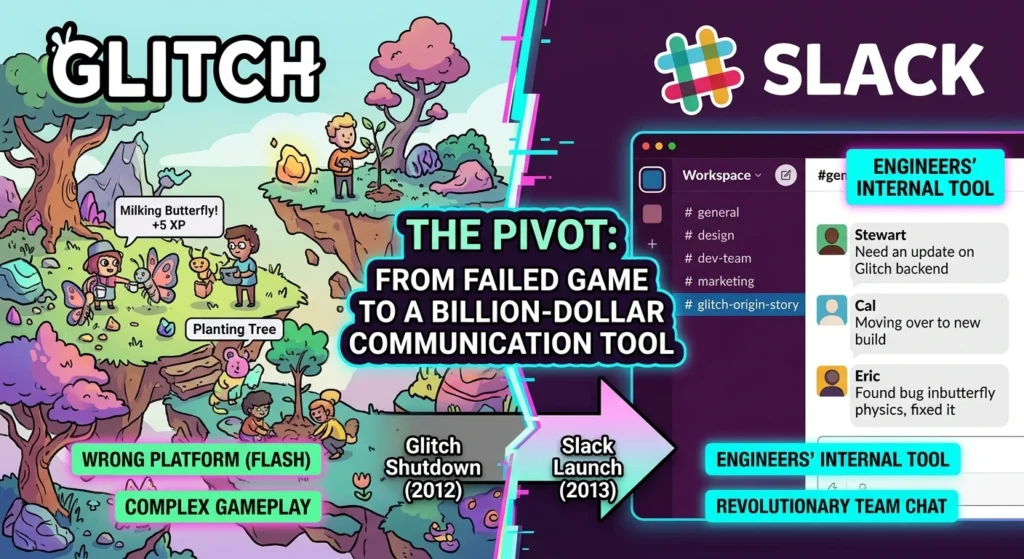
In 2009, a startup called Tiny Speck began developing an unusual online game. Lead founder Stewart Butterfield envisioned Glitch as a non-violent, collaborative world where players grew trees, milked butterflies, and explored surreal landscapes. The company raised over 17 million dollars in funding, but the game struggled to retain players.
This wasn’t Butterfield’s first time building a game that turned into something else. Years earlier, his team developed an online game called Game Neverending. When that failed to gain traction, the underlying technology became Flickr. History was about to repeat itself.
Why Glitch Couldn’t Survive the Market Shift
Wrong Platform and Technical Headwinds
Glitch officially launched in late 2011, but the timing was difficult. The game relied heavily on Adobe Flash just as smartphones and mobile gaming were taking over the market. The architecture made the game expensive to run, complex to build, and hard to port to mobile devices, highlighting the need for affordable mobile app development solutions for every idea.
Player Confusion and Onboarding Issues
Beyond the platform challenges, the quirky mechanics confused mainstream gamers, who often didn’t understand what they were supposed to do. By late 2012, running the game was burning cash too quickly. Butterfield made the call to shut down Glitch’s servers, leaving the company at a critical crossroad.
The Secret Weapon Hidden in Their Internal Tooling
While building Glitch, Tiny Speck faced a major operational problem. Their team was spread across San Francisco, Vancouver, and New York, making daily technical coordination difficult without reliable remote IT support for small businesses. Email was too slow, and standard chat tools at the time were frustratingly clunky, leading many modern teams to seek more efficient co-managed IT services to streamline their operations.
To solve this, the engineers built their own internal messaging app. They named it the Searchable Log of All Conversation and Knowledge, or Slack for short. It was never meant to be a commercial product—it was just basic infrastructure to keep distant team members in sync.
The gamers weren’t sticking around for Glitch, but the employees loved using their internal chat tool. They realized they couldn’t imagine working without it.
How a Failed Video Game Became Slack in the Enterprise World
When Glitch officially closed in December 2012, Butterfield realized the company’s real asset had been in front of them the whole time. The team pivoted, pouring their remaining capital into turning the internal chat tool into a standalone product, a process that requires the same level of care as professional website redesign in Delaware.
They kept the video game influence intact during the redesign. Unlike traditional workplace software, Slack used vibrant colors, playful language, and a helpful digital assistant named Slackbot. When the app launched publicly, it spread through word-of-mouth faster than almost any prior enterprise tool.
Slack proved to modern software teams that workplace tools do not have to be boring, much like how personalized IT solutions for small businesses can transform a dull office environment into a productive hub. If you want to read more about building products people actually want to use, see our guide on [product market fit strategies].
Key Takeaways From the $27 Billion Pivot
Slack was eventually acquired by Salesforce for 27.7 billion dollars in 2021, showing that a failed product can still generate valuable data. Here are a few key lessons from their journey:
* **Pay attention to internal tools:** The secondary system you build to solve your own pain point is sometimes more valuable than your main product.
* **Do not fear the hard pivot:** Holding onto a dying vision burns capital, while pivoting early can launch a successful business.
* **Inject delight into boring categories:** Bringing video game design thinking to enterprise software successfully disrupted workplace communication.
Slack remains one of the most notable pivots in tech history. It serves as a reminder that the best ideas are often right in front of you, provided you are willing to let go of what failed.