(302) 262 8484
How Google’s Early Storage Setup Was Built With LEGO Bricks

The Humble 40GB Array That Powered a Tech Giant
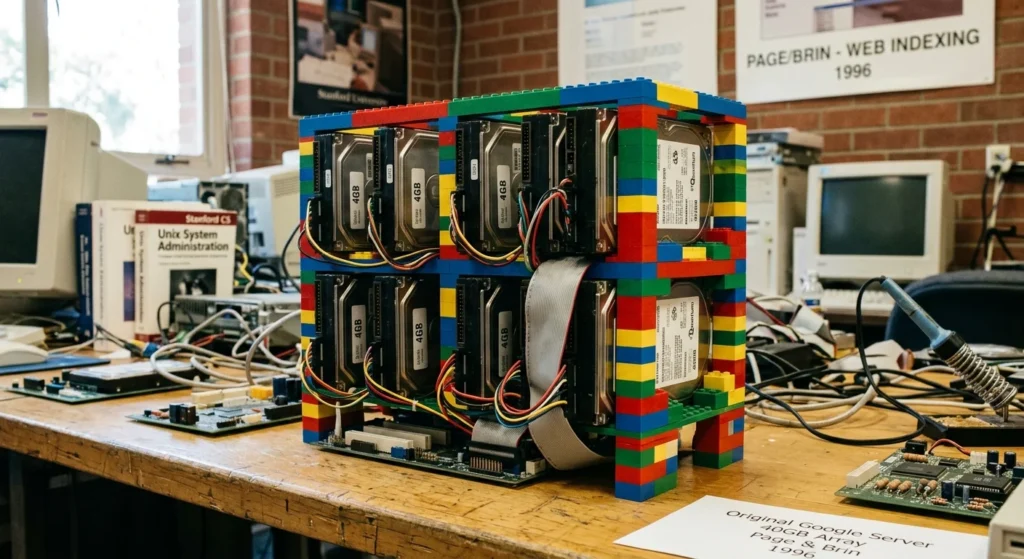
Before Google became a tech behemoth processing billions of searches a day, it was just an ambitious research project running out of a Stanford University dorm room. Back in 1996, co-founders Larry Page and Sergey Brin ran into a major hardware problem while indexing the web. They needed massive disk space, but expensive server equipment was far beyond their graduate student budget. That is how Google’s early storage setup was built with LEGO bricks.
Why Modular Toy Bricks Solved a Hard Drive Problem
In 1996, consumer hard drives topped out at a modest 4 gigabytes each. To crawl and index millions of web pages, Page and Brin calculated that they needed at least 40 gigabytes of total capacity. Their solution was simple yet radical: wire ten 4GB drives together into one big custom array.
The real challenge was housing all those drives safely without spending thousands of dollars on custom enterprise racks. Standard desktop PC cases could not fit ten drives at once, and custom metal fabrication was out of the question.
Enter LEGO bricks.
The colorful plastic blocks were inexpensive, adaptable, and surprisingly sturdy. Better yet, their snap-together modular design meant the founders could quickly rebuild the structure whenever they needed to swap out a faulty drive or expand their storage.
Quick Facts About Google’s First Server Enclosure
- Total Capacity: 40 gigabytes across ten 4GB hard drives
- Creators: Larry Page and Sergey Brin
- Location & Year: Stanford University, 1996
- Primary Benefit: Cheap, modular expansion for custom drive mounts
- Legacy: Preserved and displayed as tech history at Stanford
Practical Innovation Beats Expensive Hardware
Here’s the thing about tech history: expensive equipment does not guarantee a successful product. Larry and Sergey proved that resourcefulness matters far more than shiny corporate hardware.
By building Google’s early storage setup out of simple plastic bricks, they kept their focus where it belonged, on refining their groundbreaking search engine. The quirky setup housed the hard drives, but their page-ranking algorithm changed how the world finds information.
What Modern Founders Can Learn From Google’s DIY Past
Modern tech teams often fall into the trap of over-engineering their infrastructure before proving their actual product. Buying high-tier cloud subscriptions or custom hardware feels like progress, but it quickly drains vital capital, which is why many companies prefer scalable IT services for small businesses.
Google’s early storage setup proves that practical solutions always beat perfect conditions. When you are validating a fresh concept, build with whatever tools you have on hand, or consult with experts in IT infrastructure for small businesses to ensure your foundation is sound. Your setup does not need to look pretty as long as it handles the workload.
Interested in reading more about scalable systems? See our guide on technical infrastructure strategy.
From Toy Bricks to Global Data Centers
So what does that mean for you? Next time you face a frustrating budget limit or a tough technical bottleneck, remember how one of the biggest companies on earth relied on personalized IT solutions for small businesses to overcome early hurdles. Earth got started.
That legendary 1996 LEGO drive enclosure now sits in a display case at Stanford University. It serves as a great reminder that giant breakthroughs often start with basic tools and a bit of practical creativity.