(302) 262 8484
Coldcard Bitcoin Wallets Compromised: How a $89 Million Flaw Exposed Self-Custody’s Biggest Weakness

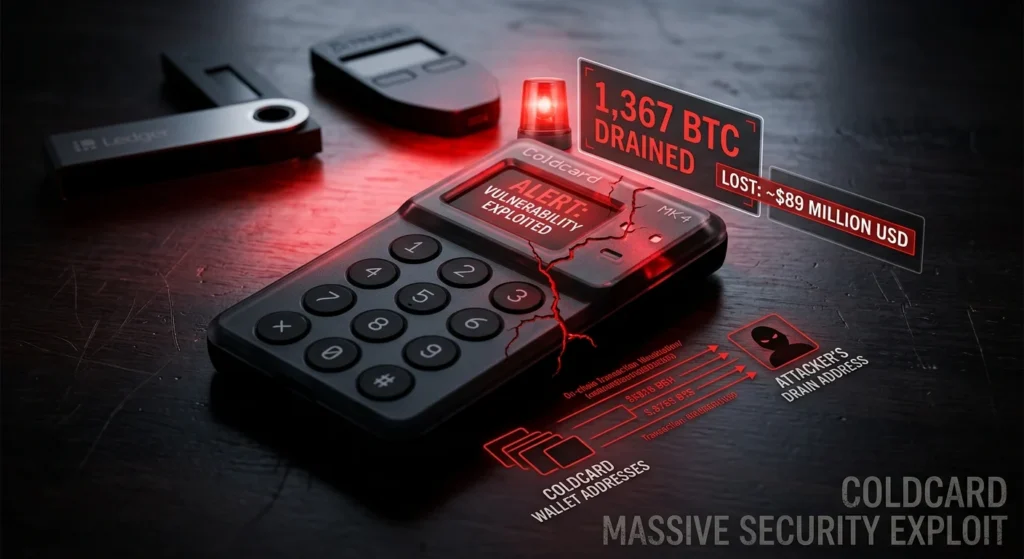
Back in late July 2026, the crypto space took a massive hit. A lot of hardcore self-custody advocates woke up to their absolute worst nightmare. News dropped that Coldcard Bitcoin wallets had been compromised in a massive security exploit. Overnight, what we all considered one of the safest, most bulletproof hardware wallets on the market turned into the source of a massive drain. And it has already wiped out nearly 89 million dollars in Bitcoin.
This wasn’t your run-of-the-mill phishing scam. Nobody physically broke into a vault. It was a deep, architectural failure in exactly how these devices generated their security keys. If you happen to use a Coldcard, you need to jump on this immediately. Because just running a quick software update is not going to save your money.
So, What Actually Happened to These Coldcard Wallets?
According to the on-chain researchers over at Galaxy Research, attackers found and exploited a massive firmware vulnerability. They hit in a few distinct waves starting around July 30, 2026. The hackers managed to systematically drain about 1,367 BTC from over 4,500 different wallet addresses. By early August, total losses blew past the 88 million dollar mark. And honestly, some estimates put that number even higher as more victims finally check their balances.
Here is the terrifying part. The victims didn’t do a single thing wrong. They never clicked on a shady link. They didn’t accidentally type out their recovery phrases somewhere online. Most of them had their physical devices locked away in heavy-duty safes. Yet, their funds were swept in a matter of minutes. The entire flaw comes down to how the wallets built their master keys.
The Root Cause: How Seed Phrases Got Predictable
Every hardware wallet uses a random number generator to build your seed phrase. That randomness—or entropy—is what makes it mathematically impossible for a hacker to guess your 12 or 24 words. If the math is solid, your wallet stays secure, but you should also consider proactive IT monitoring for small business to ensure your broader digital environment remains safe.
But here is where it all fell apart. A software bug slipped into a March 2021 firmware update and completely broke that math. Instead of using the highly secure hardware random number generator built right into the physical device, the affected firmware defaulted to a weak, non-cryptographic pseudo-random number generator. This massive error knocked the entropy of those generated seed phrases down to as low as 40 bits.
Just to give you some context, 40 bits of entropy is incredibly weak. Instead of trying to guess one specific seed out of trillions of random possibilities, hackers only had to scan a tiny, highly predictable pool. Once the attackers figured out the pattern, they just wrote scripts to generate those weak seeds, checked to see which ones actually held Bitcoin, and swept the funds, proving that the brutal truth about how fast a weak password gets cracked applies to all security layers.
Which Models and Firmware Versions Are Actually Affected?
This vulnerability hits a bunch of different Coldcard generations. If you generated your seed phrase using any of the models and firmware versions below, your wallet is at severe risk:
- Coldcard Mk2 and Mk3: You are looking at firmware versions 4.0.0 right through 4.1.9.
- Coldcard Mk4 and Mk5: Any firmware version older than 5.6.0.
- Coldcard Q: Anything running a version before 1.5.0Q.
- Edge builds: Any builds prior to 6.6.0X.
Now, listen to this part because it really matters. Even if you updated your firmware to a secure version recently, your current seed phrase is still compromised. The update fixes the generator for the future. It absolutely cannot fix a weak key that was already created in the past. You have to take immediate action to secure your assets.
How to Lock Down Your Bitcoin Right Now
If you have one of these affected devices, do not sit on this. The attackers are actively running scripts right now to sweep whatever funds are left. You have to migrate your Bitcoin to a secure setup immediately.
Here is exactly how you need to lock down your funds step-by-step:
- Update your firmware: Go grab the latest patched firmware from Coinkite right away. This makes sure your device actually uses secure random number generation from here on out.
- Generate a brand new seed phrase: Seriously, do not reuse your old 12 or 24 words. You need to generate a completely fresh seed phrase on the newly updated device.
- Transfer your funds: Move all your Bitcoin out of that old, compromised wallet and send it straight to the new address you just made.
- Toss the old seed: Never use or fund that compromised seed phrase ever again. Just get rid of it.
If you want to dig into the details on hardware security, check out our guide on [cold storage best practices].
The Open-Source Debate: A Hard Lesson in Trust
So, what does all this actually mean for the rest of us? Beyond the immediate financial hit, this exploit fired up a massive debate about open-source software across the Bitcoin ecosystem.
Back in 2021, Coinkite changed Coldcard’s licensing. They moved away from a fully open-source model to a restricted, “source-verifiable” setup. Developers could still read the code, sure. But they couldn’t legally use it for their own projects anymore. A lot of security experts argue this shift was entirely about commercial interests, rather than keeping users secure.
“Bugs get found when people actually work with the code, not just when they read it. If Coldcard’s code had stayed fully open source, someone probably would have spotted and patched this vulnerability years ago.”
When you have fewer independent developers actively building on and testing a codebase, bad bugs slip through the cracks. This 89 million dollar disaster is a really painful reminder. True open-source transparency isn’t just some philosophical preference. It is a hard security requirement.
The Big Takeaway for Crypto Self-Custody
At the end of the day, self-custody is still your best bet for securing digital wealth. But it isn’t entirely foolproof. Hardware wallets are still just computers, and computers are always subject to human error. If you own a Coldcard, go check your firmware history today. Taking twenty minutes to migrate your funds right now could literally be the difference between keeping your Bitcoin and watching it vanish into a hacker’s wallet.