(302) 262 8484
Why Bluetooth Is Named After a Viking King (And How the Name Stuck)

You probably use Bluetooth every single day. Whether you are connecting wireless earbuds or streaming music to a portable speaker, that little blue icon is everywhere. But did you know that Bluetooth is named after a king who ruled Scandinavia over a thousand years ago?
It sounds more like the nickname of a mythical pirate than a modern piece of wireless technology. Here is the true story of how a 10th-century Viking monarch inspired one of the most famous tech brands in history.
Who Was King Harald Bluetooth?
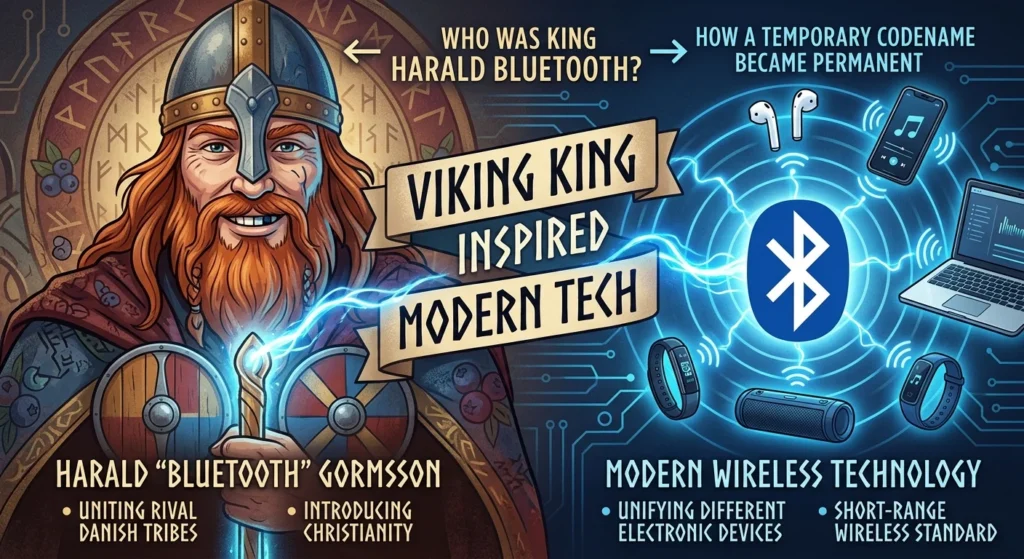
Back in the 10th century, King Harald Gormsson ruled Denmark and Norway. He was famous for two major achievements: introducing Christianity to Scandinavia and unifying rival Danish tribes under a single kingdom.
So why was he called Bluetooth? Historians still debate the origin of his colorful moniker, but two main theories stand out:
- He had a dead or decayed tooth that looked noticeably dark blue or gray.
- He loved blueberries so much that his teeth were constantly stained.
Either way, the name stuck. Little did King Harald know that his nickname would re-emerge a millennium later inside billions of electronic devices.
How a Temporary Codename Became Permanent
In 1997, major tech companies like Intel, Ericsson, and Nokia were working together to create a single short-range wireless standard. They wanted a universal way for computers, mobile phones, and accessories to talk to each other without messy cords, which is why professional IT consulting is so important for modern connectivity.
Jim Kardach, an Intel engineer on the project, was catching up with Sven Mattisson, an engineer at Ericsson. Mattisson had been reading Scandinavian history and brought up King Harald Bluetooth and his ability to bring divided groups together.
The Analogy That Saved the Name
Kardach instantly saw the connection. Just as King Harald united Scandinavia under one crown, this new wireless technology would unite different electronic devices under one system.
He suggested Bluetooth as a temporary project codename. The marketing teams fully intended to replace it with a polished corporate name before launch, considering options like RadioWire or PAN (Personal Area Networking).
Then reality hit right before the official announcement.
- PAN was the leading candidate, but a quick search revealed the acronym was already heavily used across the internet.
- RadioWire was the backup, but trademark checks could not be completed in time for the scheduled launch.
With no other choice left, the team launched using the temporary codename. To everyone’s surprise, the name took off immediately across the tech industry.
The Hidden Meaning in the Bluetooth Logo
The connection to ancient Norse history goes beyond the name itself. If you take a close look at the Bluetooth logo, you are looking at a medieval cipher, a level of detail that reminds us why proactive IT monitoring for small business is essential for keeping complex systems secure.
The logo is a bind rune, which merges two characters from the ancient Younger Futhark runic alphabet:
- Hagall (ᚼ): Represents the letter H.
- Bjarkan (ᛒ): Represents the letter B.
When you stack those two runes on top of each other, they form the iconic Bluetooth symbol. It is a subtle nod to King Harald’s initials hidden in plain sight on your screen.
Why the Unconventional Name Worked
Most technology names from the late 1990s were dry and packed with jargon. If the creators had gone with RadioWire or PAN, the standard might have faded into the background as just another boring spec.
Instead, an accidental codename borrowed from Viking history gave the standard personality. It turned complex engineering into something distinct and memorable.
The next time your phone pairs with your car or headphones, remember the story behind it. You are using technology named after a Viking king who brought people together and probably had a very dark tooth.