(302) 262 8484
AMD vs Intel for Gaming: Who Wins?

You are staring at a spec sheet. You have to make a choice that will dictate how your next computer performs for years. The AMD vs Intel debate has been raging for decades, but right now, the competition is closer than ever. Let us break down exactly which processor brand deserves your money.
Years ago, Intel was the default choice for almost everyone. AMD was just the quirky budget alternative. That is definitely not the case anymore.
The launch of AMD Ryzen completely changed the desktop and laptop markets. It forced Intel to stop resting on its laurels and innovate rapidly. Now, both companies make fantastic processors. But they take very different approaches to getting the job done.
If you are building or buying a PC primarily to play games, you want maximum frame rates. Right now, AMD has a distinct edge in this category.
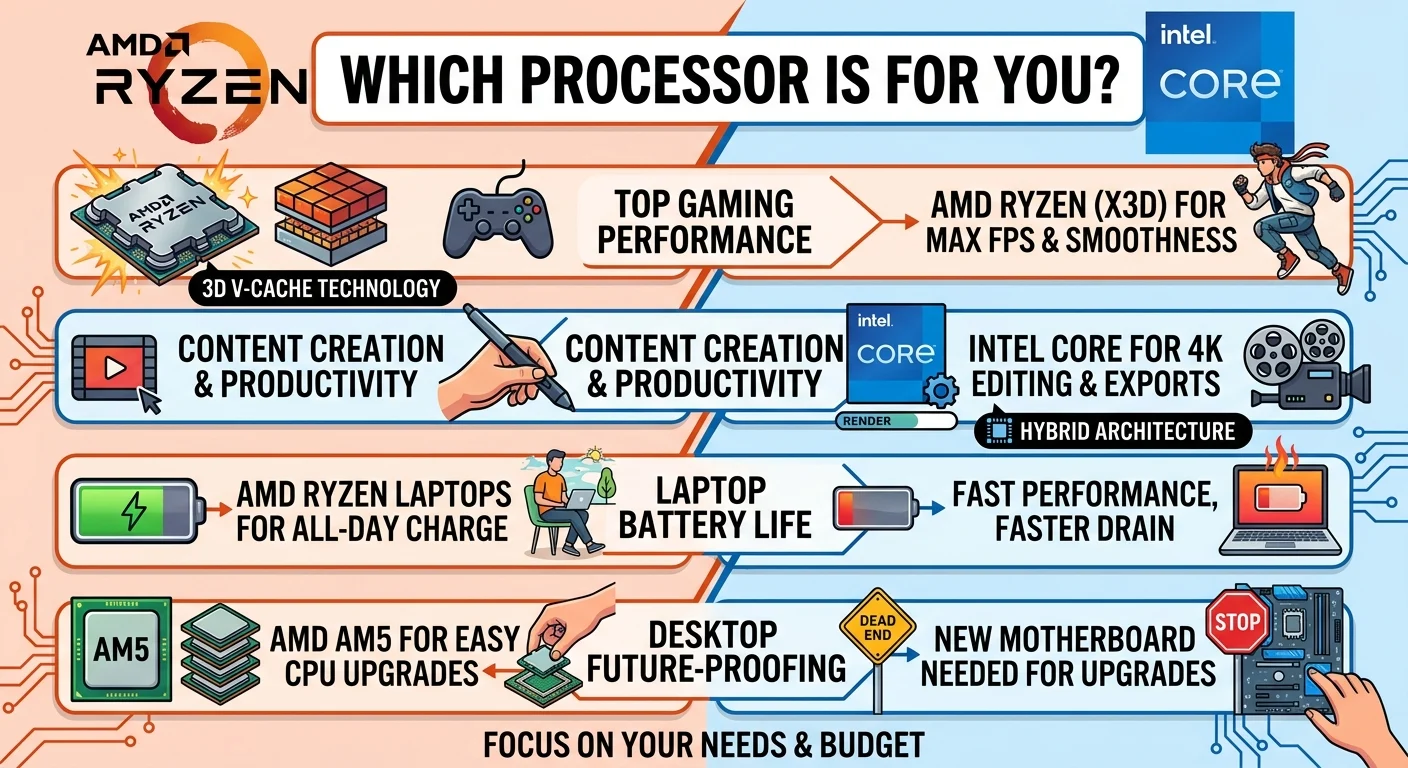
Their secret weapon is 3D V-Cache technology. Processors like the Ryzen 7 7800X3D pack a massive amount of cache directly onto the chip. This results in incredibly smooth gameplay and high frame rates. You will especially notice this at 1080p and 1440p resolutions.
Intel is still a powerhouse here. Their Core i5 and Core i7 chips push very high clock speeds. They will run any game you throw at them flawlessly. But if we are talking strictly about top-tier gaming performance, AMD takes the crown.
The Magic of 3D V-Cache
Why does cache matter so much? It allows the processor to store crucial game data right next to the cores. The CPU does not have to constantly ask your system RAM for information. This drastically reduces stuttering and makes your games feel incredibly responsive.
Productivity and Heavy Workloads
Now, this is where it matters for creative professionals. If you edit 4K video, render 3D models, or run heavy software, the story shifts.
Intel usually pulls ahead in heavy productivity tasks. They use a unique hybrid architecture. Intel splits their processors into Performance cores and Efficient cores. The heavy lifting goes to the big cores. Background tasks get pushed to the smaller ones.
This makes Intel Core processors incredibly smooth when you have a dozen apps open at once. Intel also typically offers slightly better optimization for Adobe Premiere and similar professional software.
The best processor is not the one with the highest benchmark score. It is the one that flawlessly handles what you actually do every day.
AMD chips are certainly no slouch in productivity. A high-end Ryzen 9 will chew through a massive video render. But Intel generally gives you a slightly smoother experience for complex creative workflows.
Laptops and Battery Life
Desktop PCs are one thing. Laptops are a completely different battleground.
When comparing AMD vs Intel in laptops, power efficiency is the most critical factor. You want a laptop that stays cool and lasts all day on a single charge. Here is the thing about modern laptops. AMD Ryzen processors generally run cooler and use less power.
If battery life is your top priority, look for a laptop with an AMD chip. Intel laptops often deliver slightly faster burst performance. However, they tend to drain the battery faster and run hotter under heavy load.
Platform Longevity and Upgrades
This is a massive factor if you plan to build your own desktop PC. It dictates how much money you will have to spend three or four years from now.
AMD is famous for keeping the same motherboard socket for years. If you buy an AM5 motherboard today, you can likely drop a brand new processor into it years down the road. You will not have to rip your entire computer apart to upgrade.
Why Sockets Matter
Intel changes their motherboard sockets frequently. It is honestly a little frustrating. If you buy a 14th-generation Intel chip today, your upgrade path is basically a dead end. You will need a completely new motherboard for your next major upgrade.
If you care about future-proofing your desktop, AMD is the clear winner.
Which CPU Should You Buy?
Still not sure? So what does that mean for you right now at the checkout screen? Here is a quick breakdown to help you decide.
- For pure gaming: Go with AMD. Their X3D chips are unbeatable right now for high frame rates.
- For heavy video editing: Intel is your best bet. You will get smooth timeline scrubbing and very fast exports.
- For battery life: Choose an AMD Ryzen laptop. You will spend a lot less time glued to a wall outlet.
- For budget builds: Both offer great entry-level options. Check out our guide on [budget PC builds] for specific part recommendations.
You really cannot buy a bad processor from either brand today. Pick the one that excels at the tasks you do most often. Focus on your specific needs, set your budget, and enjoy your new computer.