(302) 262 8484
Why You Are Losing Traffic Without Realizing It

You put in the hours. You write helpful content, update your plugins, and wait for the organic traffic to roll in. But instead of climbing the charts, your numbers are flatlining. Or worse, your traffic is slowly bleeding out over time.
It is a frustrating spot to be in.
If you feel like you are doing everything right but still struggling to get visibility, you are not alone. There is a very good chance something invisible is tanking your website search engine ranking. Effective SEO and SEM in Delaware is not just about what you can see on the page. It is often about what is happening behind the scenes, such as ensuring you have reliable ongoing website maintenance and support in Delaware.
Google algorithms are ruthless. They actively look for technical flaws, outdated practices, and poor user experiences. If you do not catch these issues early, you may need professional website redesign in Delaware to help drag your entire domain back up.
Let us look at the sneaky issues that might be holding your site back and exactly how to fix them.
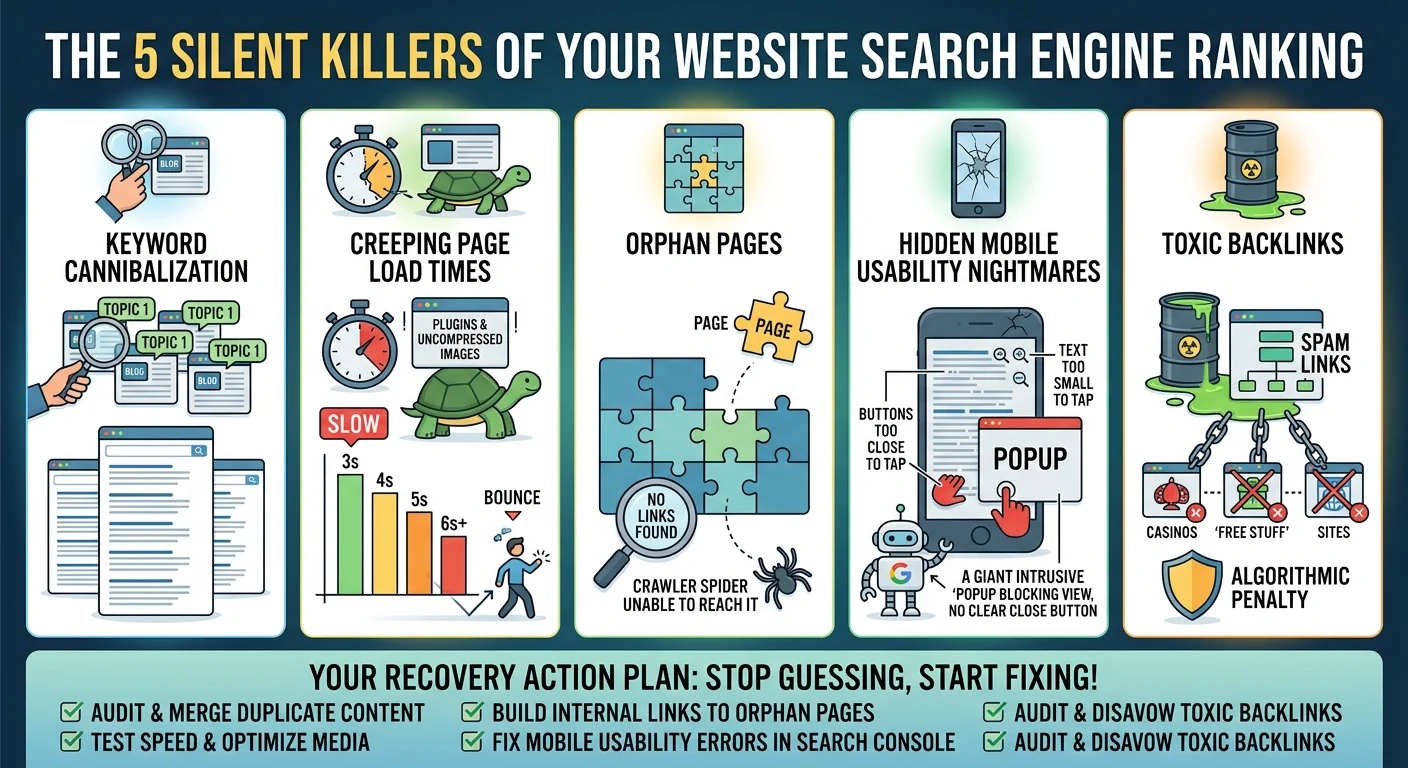
The 5 Silent Killers Destroying Your Website Search Engine Ranking
1. Keyword Cannibalization Eating Your Own Traffic
This is easily one of the most common mistakes smart content creators make. You find a topic that works well for your audience. So you write about it again. And again.
Before you know it, you have five different blog posts targeting the exact same search intent. You might think you are building authority, but you are actually forcing your own pages to compete against each other.
When Google sees multiple pages from the same site answering the exact same question, it gets confused. It does not know which page is the most authoritative. As a result, it often chooses to rank none of them.
To fix this, you need to consolidate. Find your competing pages and merge the best content into one massive, highly valuable resource. Then redirect the old URLs to the new master page. If you need help identifying these overlaps, see our guide on [how to run a content audit].
2. Creeping Page Load Times
You probably tested your site speed when you first launched. It was lightning fast. But that was two years ago.
Since then, you have added new features. You installed a dozen new plugins. You uploaded massive image files directly from your phone without compressing them. Slowly but surely, your site got heavy.
Page speed is a massive factor for your website search engine ranking. If your site takes more than three seconds to load, the majority of your visitors will hit the back button. Google tracks this behavior. They call it pogo-sticking. If users constantly bounce from your site back to the search results, Google assumes your site is a bad result and drops your rank.
Run your site through Google PageSpeed Insights today. Pay special attention to your Core Web Vitals and start compressing your images.
3. Orphan Pages Floating in the Void
Imagine building a beautiful storefront but forgetting to build a road that leads to it.
That is what happens when you create orphan pages. An orphan page is a piece of content on your site that has zero internal links pointing to it. You might have published a brilliant guide, but if you did not link to it from your older posts or your main navigation, it is basically invisible.
Search engine crawlers navigate the web through links. If a page has no links pointing to it, crawlers have a very hard time finding it. Even if they do find it via your sitemap, the lack of internal links tells Google that the page is not important.
Make it a habit to go back to your top performing articles and add links to your newly published content.
4. Hidden Mobile Usability Nightmares
You probably check your site on your own phone and think it looks totally fine. But Google does not care how it looks to human eyes. They care about how their mobile crawler experiences the code.
Google uses mobile-first indexing. This means they only look at the mobile version of your site to determine your website search engine ranking. If your desktop site is perfect but your mobile site is clunky, you will lose.
Common hidden mobile issues include:
- Buttons and links that are too close together for a finger to tap accurately
- Text that requires zooming in to read
- Popups that are impossible to close on a small screen
- Content that shifts around as the page loads
Check your Google Search Console. There is a specific report for Mobile Usability that will highlight exactly which pages are failing the test.
5. Toxic Backlinks You Forgot About
Backlinks are still the backbone of SEO. But not all links are good links.
Maybe you hired a cheap SEO agency a few years ago that built spammy links on shady forums. Or maybe a scraper site stole your content and generated hundreds of low quality links pointing back to your domain. Over time, a toxic backlink profile will absolutely crush your website search engine ranking.
Google is generally good at ignoring obvious spam. But if your site has a massive ratio of garbage links compared to high quality links, you risk getting hit with an algorithmic penalty.
You need to audit your backlink profile regularly. Use a tool to identify links from irrelevant, spammy, or dangerous domains. If you cannot get the webmasters to remove them, use the Google Disavow tool to tell search engines to ignore those links.
How to Recover Your Search Engine Visibility
If you recognize any of these silent killers on your site, do not panic. These issues are entirely fixable. The key is to stop guessing and start looking at the actual data.
Here is a quick action plan to get your site back on track:
- Audit your content: Look for duplicate topics and merge them.
- Test your speed: Remove unused plugins and compress your media files.
- Fix your internal linking: Ensure every page on your site has at least two internal links pointing to it.
- Check Search Console: Fix any mobile errors Google is warning you about.
- Review your links: Disavow the toxic junk that is holding your domain authority down.
Stop Guessing and Start Fixing
SEO is not a set it and forget it marketing strategy. The internet changes constantly. Your competitors are updating their sites, Google is updating its algorithm, and your website is naturally accumulating technical debt.
You have to stay proactive. By actively hunting down these hidden issues, you protect the hard work you have already put into your content. Take an hour this week to dig into your site diagnostics. You might be surprised by what is hiding just under the surface.