(302) 262 8484
The Song That Could Crash a Laptop: Janet Jackson’s Accidental Cyber Weapon

Imagine queueing up a favorite 1980s pop anthem, hitting play, and watching your computer instantly drop to a blue screen of death. It sounds like an urban legend, but Microsoft developer Raymond Chen confirmed that “Rhythm Nation” by Janet Jackson was literally The Song That Could Crash a Laptop. Back in the Windows XP era, this 1989 track possessed a destructive physical property that could shut down specific computers just by playing aloud.
The Song That Could Crash a Laptop: A Real Cyber-Security Threat
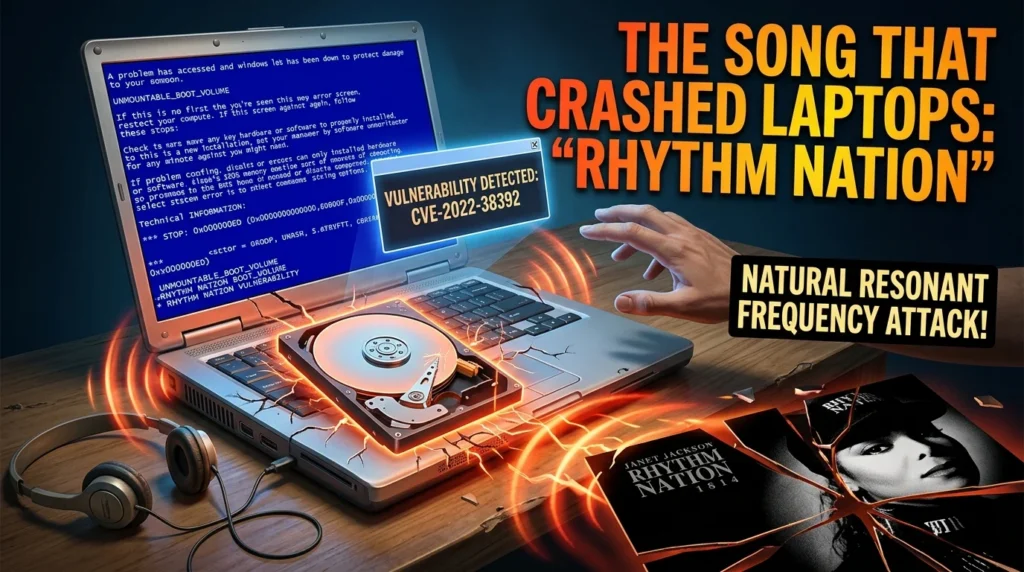
This wasn’t a software virus or a malicious hack. It was a pure physics problem. In 2022, veteran Microsoft engineer Raymond Chen shared a story from a colleague in Windows XP product support. A major computer manufacturer had discovered that playing the music video for Janet Jackson’s “Rhythm Nation” would reliably crash certain models of their laptops.
During the investigation, the manufacturer found that playing the song on one laptop would crash a completely different laptop sitting nearby. The second machine wasn’t playing the video; it just had to be close enough to hear the music.
The vulnerability was eventually recognized as a legitimate security threat and assigned an official common vulnerabilities and exposures identifier, CVE-2022-38392. It remains a uniquely strange hardware exploit.
The Physics of the Rhythm Nation Crash
The explanation lies in the mechanical design of older computers. In the mid-2000s, laptops didn’t use the silent, vibration-proof solid-state drives we have today. Instead, they relied on traditional hard disk drives that spun at 5,400 RPM.
These mechanical hard drives used a tiny read/write head hovering nanometers above a spinning magnetic platter. Every physical object has a natural resonant frequency, which is the specific frequency at which it naturally vibrates.
The heavy bassline of “Rhythm Nation” happened to contain the exact resonant frequency of the 5,400 RPM hard drives used by that manufacturer and several of its competitors. When the laptop speakers blasted those specific audio waves, the physical vibration traveled through the chassis. The hard drive began to shake in sympathy, causing massive read and write errors. The operating system couldn’t cope with the sudden loss of data access, leading to an immediate crash.
How the Song That Could Crash a Laptop Exposed Drive Fragility
Mechanical hard drives are highly sensitive instruments that rely on perfect physical alignment. To understand how delicate they are, consider these facts about mechanical storage:
- The read/write head flies above the platter at a distance smaller than a human hair or a particle of dust.
- Even minor external vibrations can cause the drive head to temporarily lose its tracking.
- Shouting loudly in a server room has been documented to cause performance drops in enterprise storage arrays.
- Resonant frequency issues can permanently damage physical components if the vibration is intense enough.
For more on how physical vulnerability affects computing, check out [our guide on hardware history].
How Microsoft and OEMs Fixed the Rhythm Nation Glitch
The manufacturer fixed this physical vibration problem without recalling millions of laptops by using a software workaround. They created a custom audio processing filter, known as an Audio Processing Object, and inserted it directly into the Windows audio pipeline.
This filter constantly analyzed outgoing audio and removed the specific offending frequencies before they could reach the laptop speakers. Since those frequencies were gone, the speakers never vibrated at the danger threshold, and the hard drives remained safe.
The Secret Windows Filter That Saved Laptops for Years
This patch remained active in Windows long after those 5,400 RPM hard drives faded from the market, as Chen revealed in a follow-up post.
When Windows 7 was in development, Microsoft introduced a rule requiring users to have the option to disable all audio enhancements with a single checkbox. The laptop manufacturer immediately asked Microsoft for a special exception.
Their logic was straightforward. If a user unchecked that box to get a richer, unfiltered bass sound, the protective filter would turn off. The user would play “Rhythm Nation,” crash their laptop, and blame Windows or the PC brand. Microsoft granted the exception, and the filter was allowed to run in the background, keeping laptops safe from the song for years.
What This Teaches Us About Tech Design
This incident demonstrates that hardware and software do not exist independently. The digital environment remains constrained by physical reality.
Today, almost all modern laptops use solid-state drives, meaning they are completely immune to acoustic resonance attacks. But not too long ago, a heavy bassline could literally shake a computer to death.