(302) 262 8484
Why the PlayStation Exists Because of a Nintendo Deal Gone Wrong

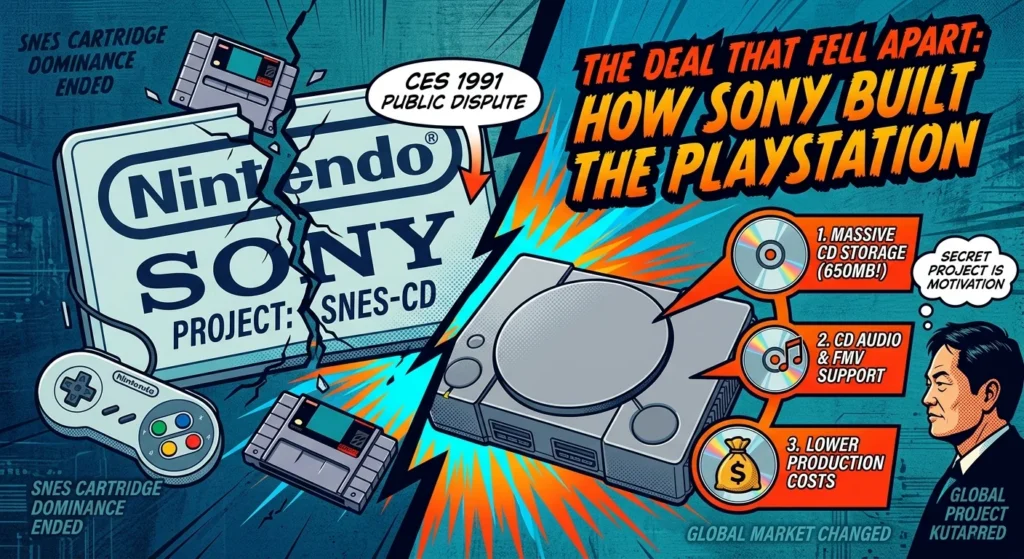
The PlayStation exists today largely because of a broken corporate partnership. In the late 1980s, Sony and Nintendo were working together on a new piece of gaming hardware. That deal fell apart after a public dispute at a major electronics trade show, starting a rivalry that permanently changed the video game industry.
Instead of dropping the project, Sony used the cancelled partnership as motivation, proving that even when technology projects face setbacks, professional IT consulting can help navigate the path forward. They developed a standalone console that eventually took over the global market and ended Nintendo’s dominance in home video games.
The Secret Deal That Started It All
The origins of this rivalry trace back to 1988. Ken Kutaragi, a Sony engineer who saw the potential in video games, secretly designed an advanced sound chip—the SPC700—for Nintendo’s upcoming Super Nintendo Entertainment System (SNES). He did this without corporate approval.
When Sony executives found out, they nearly fired him. But Sony CEO Norio Ohga recognized the value of Kutaragi’s work and allowed him to finish the project. The sound chip was a success, giving the SNES a notable audio advantage over its main competitor, the Sega Genesis.
The SNES-CD and the Original Hybrid Console
Following the success of the audio chip, Nintendo and Sony signed an agreement to develop a CD-ROM add-on for the SNES. Sony also intended to release its own branded all-in-one console, tentatively called the Play Station or Nintendo PlayStation. This hybrid machine would play standard SNES cartridges as well as new CD-ROM games.
At the time, compact disc technology offered distinct advantages over traditional game cartridges:
- Massive storage capacity compared to limited cart memory
- Significantly lower production costs for game publishers
- Support for high-quality audio tracks and full-motion video
The partnership seemed promising, but a serious contractual disagreement over those CDs was about to become public.
Why the PlayStation Exists: The Dispute at CES 1991
As Sony prepared the hardware, Nintendo president Hiroshi Yamauchi reviewed the contract’s fine print. The terms gave Sony broad control over software licensing, media formats, and royalties for all CD-ROM games released on the system. Yamauchi maintained strict authority over Nintendo’s platform revenue and refused to give those rights to Sony, a move that highlights why businesses must prioritize small business cybersecurity protection to safeguard their own proprietary assets.
Rather than renegotiating the contract directly, Nintendo opted for a different approach.
The Announcement in Chicago
On June 1, 1991, at the Consumer Electronics Show (CES) in Chicago, Sony officially unveiled the Nintendo PlayStation prototype, presenting it as a joint venture.
The next morning, Nintendo held its own press conference at the same event. Instead of acknowledging the Sony deal, Nintendo announced a new partnership with Sony’s competitor, Philips, to produce CD hardware for the SNES. Sony executives in attendance were caught entirely off guard on live television.
The public nature of the announcement provoked a strong response from Sony, leading them to prioritize robust hardware development and secure their own internal IT infrastructure for small businesses and large enterprises alike.
Developing a Competing Console
After the CES announcement, several high-level Sony executives wanted to leave the video game market entirely, as mainstream business leaders still viewed gaming as a risky fad. But Ken Kutaragi wanted to see his work through, and CEO Norio Ohga remained angry over Nintendo’s breach of trust.
Ohga directed Kutaragi to build a new machine capable of competing directly with Nintendo. With upper management’s backing, Kutaragi’s team focused on developing a 3D console built specifically around optical discs.
How the Original PlayStation Changed Gaming
Sony released the standalone PlayStation in late 1994, and it quickly gained traction. Game developers preferred the hardware because manufacturing CDs was much cheaper and faster than producing expensive N64 cartridges. Several major game studios eventually stopped making games for Nintendo and brought their major franchises exclusively to Sony’s platform.
If Nintendo had honored its original contract, the current console market would look completely different.
By trying to protect its software royalties, Nintendo inadvertently created its strongest competitor. That single broken deal launched the PlayStation brand and fundamentally changed how video games are made, sold, and played.