(302) 262 8484
The Unexpected Origin of the @ Sign in Email

If you have ever typed a digital message, you have used the character sitting above the number two key. The @ sign’s role in email dates back to late 1971, when a computer engineer needed a single key that nobody else was using.
Before becoming a standard part of modern communication, the symbol was an obscure character on teletype keyboards. A single programmer repurposed this forgotten accounting mark for digital messaging.
The Unexpected Origin of the @ Sign in Email and the 1971 ARPANET Breakthrough
In 1971, Ray Tomlinson was a computer programmer at Bolt Beranek and Newman in Cambridge, Massachusetts. His work focused on ARPANET, an early packet-switching network that laid the foundation for the modern internet and the robust IT infrastructure for small businesses we rely on today.
Basic messaging already existed on computers, but users could only send notes to people logged into the exact same physical machine. Tomlinson wanted to route a message composed on one machine across a network to a specific inbox on a different host, a process that remains critical for modern remote IT support for small businesses.
Solving the Digital Messaging Puzzle
To make inter-computer communication work, Tomlinson combined a local messaging program called SNDMSG with a file transfer program named CPYNET. The hybrid code worked, but it introduced a practical design problem.
The software needed a way to separate the user’s name from the destination computer’s name. If a message was addressed to a user named ‘Tom’, the system had to know whether Tom was local or located on a distant network node.
Tomlinson needed a clean separator character, and finding the right one was surprisingly difficult.
Why Ray Tomlinson Selected the @ Symbol
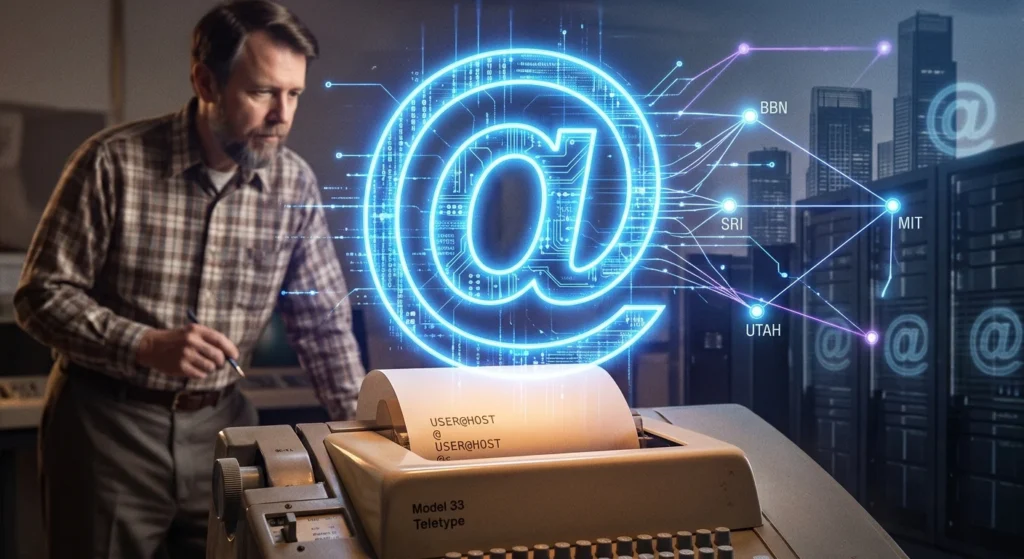
Tomlinson looked at his Model 33 Teletype keyboard for a character that met three specific rules:
- It could not be a letter or number commonly found in user names.
- It could not be a punctuation mark like a comma or slash that might confuse system commands.
- It needed to make immediate sense to a human reader.
The @ character fit perfectly. In 1971, almost nobody used it. Merchants and accountants typed it to indicate unit prices, such as 5 apples @ 10 cents, but programmers largely ignored it. Most importantly, the character literally meant ‘at’.
From Accounting Shortcut to Digital Icon
When Tomlinson typed the first address, the format felt natural. Typing a username followed by the @ sign and the destination machine created a readable instruction: user at host.
He did not hold a press conference or file a patent. Instead, he sent a test message between two computers sitting next to each other in his Cambridge lab. The text of that first message was just a random string of letters, similar to ‘QWERTYUIOP’.
A Casual Moment in the Lab
Tomlinson reportedly showed the new messaging tool to his colleague Jerry Burchfiel with a warning. He asked Burchfiel not to tell anyone, noting that messaging was not what they were officially hired to build.
Despite the quiet rollout, the invention spread quickly. Within two years, a study showed that electronic mail accounted for roughly three-quarters of all data traffic moving across the ARPANET.
The Origin of the @ Sign in Email Before Computers
While Tomlinson established the symbol’s modern use, the mark itself predates manufactured keyboards by centuries. Historians have identified several pre-digital uses for the character:
- Medieval Manuscripts: Monks copying texts merged the Latin word ad (meaning ‘at’ or ‘toward’) into a single fluid stroke to save ink and parchment.
- 16th-Century Trade: Spanish and Italian merchants used the mark as an abbreviation for an arroba, a traditional unit of weight used for grain and wine.
- 19th-Century Typewriters: Keyboard designers added the key so clerks could quickly type commercial invoices and ledgers.
How One Key Transformed Human Communication
Tomlinson’s choice proved so practical that it survived decades of network upgrades. When engineers eventually rewrote internet architecture, the basic address format remained exactly the same.
Today, the symbol extends well beyond the inbox. We use it to tag friends, mention creators on social networks, and organize group chats. In 2010, the Museum of Modern Art acquired the @ symbol for its design collection, recognizing it as a masterpiece of functional elegance.
Great design often involves taking an underappreciated tool and giving it a new purpose. If you want to explore how early networking choices continue to shape modern software, see our guide on [legacy internet protocols].
A split-second decision on a teletype keyboard in 1971 turned an obscure accounting symbol into a permanent fixture of digital communication.