(302) 262 8484
Your Power Strip Could Cost You Thousands: The Hidden Dangers Under Your Desk

Most of us do not think twice about the plastic bar of outlets tucked behind our desks or hidden behind the TV stand. We plug in our laptops, phones, and gaming consoles, assuming everything is perfectly safe. However, making a few dangerous power strip mistakes can quietly set you up for a financial disaster, costing you thousands of dollars in ruined gear or even a devastating house fire.
Power Strip vs. Surge Protector: The Costly Misconception
Here is the thing that many people get wrong. A power strip and a surge protector are not the same tool, even though they look almost identical on the outside.
A basic power strip is essentially just an extension cord with multiple outlets. It does not offer any real protection against electrical spikes. If a utility fault or a lightning strike sends a massive surge of electricity through your home, a simple power strip will pass that high voltage directly into your connected electronics.
Think about the math. A single high-voltage surge can instantly fry your two thousand dollar computer, your smart TV, and your gaming console in a fraction of a second. If you want to protect your expensive gadgets, you need to verify that your device is a certified surge protector, measured in joules, rather than a cheap power bar, or consider professional IT infrastructure for small businesses to safeguard your hardware.
The Most Dangerous Power Strip Mistakes You Are Probably Making
It is incredibly easy to misuse these handy devices without realizing the danger. If you want to keep your home and your wallet safe, you need to watch out for these common pitfalls.
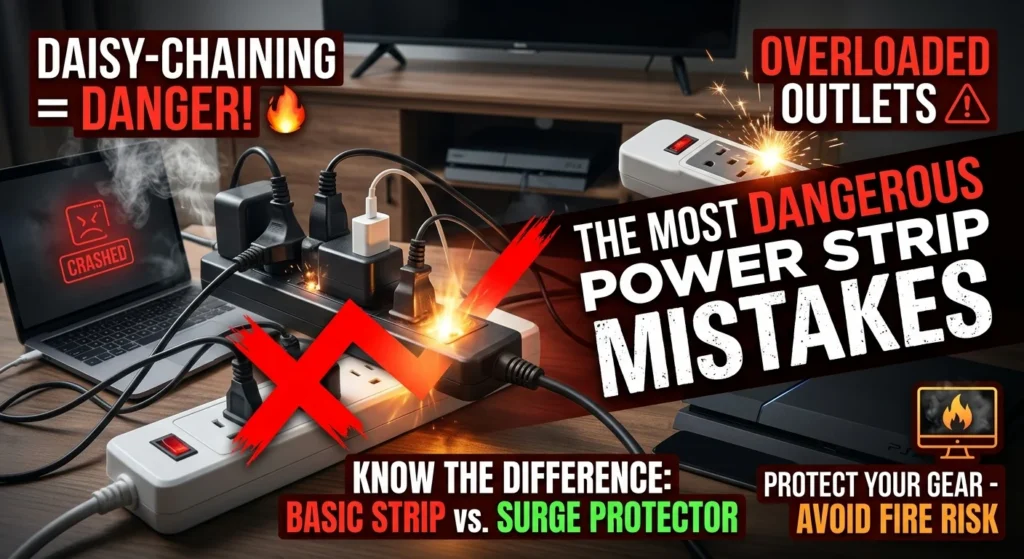
Daisy-Chaining Your Outlets
When a cord does not quite reach, the temptation to plug one power strip into another is strong. In the electrical world, this is known as daisy-chaining, and it is a recipe for disaster.
Power strips are designed to be plugged directly into a wall outlet. Daisy-chaining them bypasses their safety mechanisms, creates a serious fire hazard, and easily overloads your home circuit, which is why you should consult with experts on proactive IT monitoring for small business to ensure your electrical and tech setup remains safe. If you need more reach, buy a longer, heavy-duty extension cord instead of linking multiple strips together.
Why High-Wattage Appliances Lead to Dangerous Power Strip Mistakes
This is one of the most common issues seen by professional electricians. Power strips are built to handle low-voltage electronics like laptops, phone chargers, and lamps.
They are absolutely not designed for heavy-duty appliances that generate heat or use powerful motors. A standard household circuit can safely handle about 1,800 watts. A single space heater or microwave can easily draw 1,500 watts all by itself. If you plug that heater into a power strip alongside other devices, you will quickly overheat the internal wiring and melt the plastic casing.
Always plug these high-draw items directly into the wall:
- Space heaters and air conditioners
- Microwaves and toaster ovens
- Hair dryers and curling irons
- Refrigerators and coffee makers
Hiding Strips Under Rugs and Furniture
We all hate cord clutter, but burying your power strip under a rug or behind a heavy couch is a major safety hazard. Electrical currents naturally generate a small amount of heat. When a power strip is left out in the open, the air circulates freely and keeps it cool. If you cover it with a rug or trap it tightly against a wall, that heat has nowhere to go, which can easily ignite nearby fabrics.
The Real Cost of Electrical Fires
So what does that mean for you? The financial consequences of a power strip failure go far beyond replacing a fried computer.
According to safety organizations, electrical malfunctions cause nearly 51,000 home fires every single year in the United States. These fires result in over one billion dollars in property damage. Even worse, if an insurance investigator finds that your fire was caused by an overloaded, daisy-chained power strip, your homeowner insurance claim could be delayed or even denied.
How to Protect Your Home and Your Wallet
You do not have to live in fear of your outlets, but you do need to be smart about how you use them. Taking a few proactive steps can save you a massive headache down the road.
- Look for safety certifications: Make sure your power strips are certified by recognized testing laboratories, such as UL or CSA.
- Check the joule rating: If you are plugging in expensive electronics, use a surge protector with a rating of at least 1,000 to 2,000 joules.
- Slay the energy vampires: Consider upgrading to a smart power strip for your entertainment center. These smart devices cut off power to accessories when your main TV is turned off, which can save you money on your monthly electric bill.
- Do the touch test: Periodically feel your power strips. If any of them feel hot to the touch or smell like hot plastic, unplug them immediately.
For more home safety tips, see our guide on [electrical maintenance basics].
At the end of the day, a cheap ten dollar power strip is not worth risking your home or your expensive electronics. Take a few minutes today to look under your desk, inspect your cords, and make sure you are using your power strips safely.