(302) 262 8484
AMD’s New Radeon RX 9050 Brings Back 4GB VRAM: A Disaster for Modern Gaming

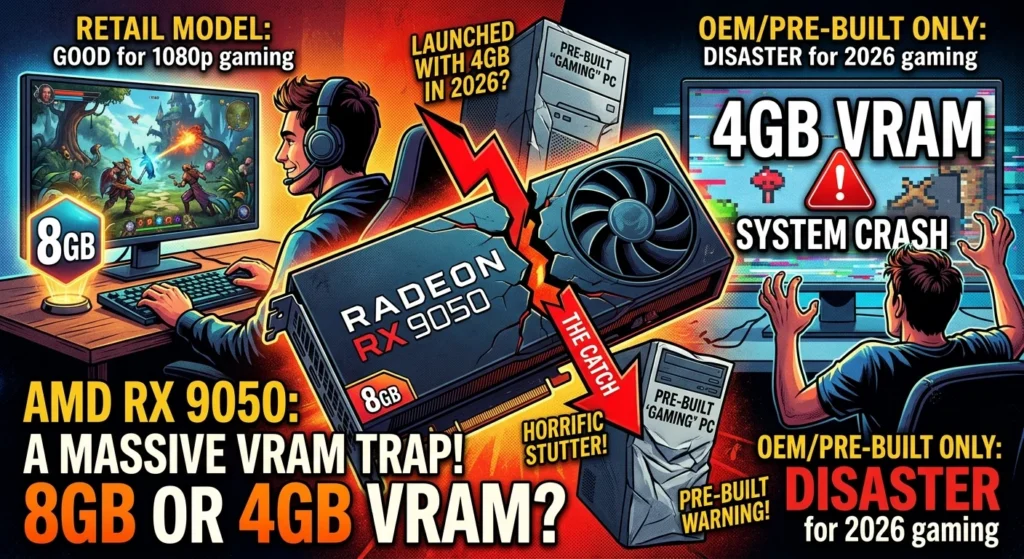
Just when we thought we were finally done with painfully low graphics memory, AMD pulled a fast one on us. The new Radeon RX 9050 is officially here. But it comes with a massive catch. The standard retail model gives you a decent 8GB of memory, which is fine. But AMD is also pushing out a heavily cut-down 4GB version. Launching a modern graphics card in 2026 with just 4GB of VRAM isn’t just a bad idea. It’s a total disaster for gaming.
Why bring back a 4GB GPU? What is AMD actually thinking?
Let’s look at the facts here. The 8GB version of the RX 9050 hits shelves at $279. It’s meant to be a budget-friendly pick for basic 1080p gaming. But AMD confirmed a 4GB version exists too. You just won’t find it sitting in a box at Best Buy. Instead, AMD is making this version exclusive to system integrators and OEMs.
And here’s the problem with that. Big companies like Dell, HP, and Lenovo are going to drop this 4GB card into pre-built desktop towers. Then they’ll market them as budget gaming PCs. Unsuspecting buyers—like parents picking up a first PC for their kids—will see that shiny new RDNA 4 branding. They’ll assume it can handle whatever new games they throw at it. But they’re in for a really rude awakening.
Why 4GB on the RX 9050 won’t run much of anything
Honestly, 4GB of video memory is completely obsolete for gaming today. Even if you drop your settings to the absolute floor at 1080p, modern games easily eat up 6GB to 8GB of VRAM just to load basic textures. And when that memory runs out? Your system has to start swapping data with your regular system RAM. That leads to horrific stuttering, which is often the first thing technicians check on slow PCs when diagnosing performance bottlenecks. Massive frame drops. Frequent crashes.
But it gets worse. The 4GB model doesn’t just lack capacity. It’s also completely starved for bandwidth. AMD chopped the memory bus down to a tiny 64-bit interface, compared to the 128-bit bus you get on the 8GB model. So the GPU can’t even access its limited memory quickly. It’s a double whammy for performance.
Try booting up any recent blockbuster on this 4GB card, and here is exactly what you’ll run into:
- Constant stuttering: You’ll see severe frame drops while the card desperately tries to swap assets back and forth.
- Low-resolution textures: Games will automatically downgrade your visuals. Everything turns into a blurry, muddy mess, and you might even experience frame pacing issues, which is a hidden spec that matters more than your FPS counter.
- Out-of-memory crashes: A lot of modern titles will just refuse to launch. Or they’ll crash straight to your desktop without warning.
- Zero future-proofing: You’re essentially paying for hardware that is already obsolete on day one.
How the 8GB model actually holds up
So what happens if you actually buy the retail 8GB model? Early testing shows it’s a decent, though pretty uninspiring, entry-level card. It runs cool. It uses less power than the competition. But it’s roughly 30 percent slower than Nvidia’s RTX 5050 in standard gaming benchmarks. For $279, it’s an okay pick for basic esports games. It just isn’t going to blow you away.
If you’re planning to build your own system, I’d highly recommend looking into professional PC upgrades in Delaware to ensure your hardware choices are balanced.commend checking out our guide on [budget PC builds] to figure out how to stretch your dollar. Grabbing a standalone card with at least 8GB—or even hunting down an older-generation mid-range card—is going to give you a vastly better experience.
The Verdict: Don’t fall for the 4GB trap
I really can’t stress this enough. Do not buy a pre-built PC if it has the 4GB Radeon RX 9050 inside. It’s basically e-waste disguised as a modern gaming part. The 8GB version definitely has a niche for ultra-budget builders who care about low power consumption. But the 4GB model? It’s just a trap. AMD is using it to clear out cut-down silicon, and uninformed gamers are the ones paying the price. Keep your money. Do your research. And make sure you buy a card that actually has the memory to handle today’s games.