(302) 262 8484
If Your Business Team Uses WhatsApp, Read This Immediately

If your business team uses WhatsApp to close deals, chat with clients, or coordinate daily tasks, you might think you are just being efficient. It is fast, everyone has the app, and clients love the personal touch. But behind that effortless convenience lies a massive compliance minefield, operational risk, and a shifting landscape of platform rules that could shut you down overnight.
The Multi-Million Dollar Compliance Trap
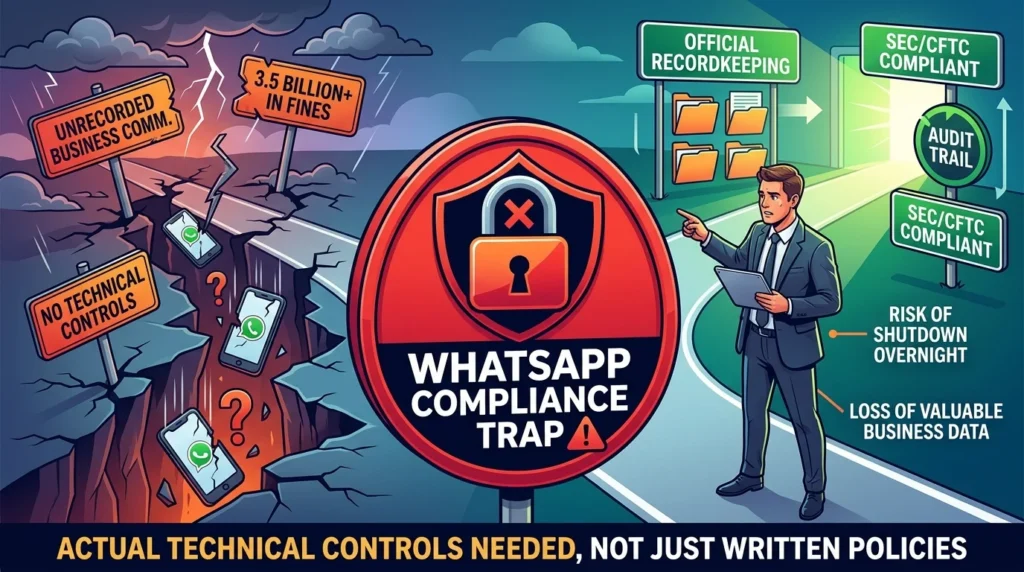
Let us look at the hard numbers. Regulators like the SEC and the CFTC have handed out more than 3.5 billion dollars in fines for unrecorded business communications on apps like WhatsApp. While the heaviest fines hit Wall Street giants, the message from regulators is loud and clear. If you operate in a regulated industry, you must keep a complete, unalterable audit trail of your client communications.
Here is the thing. Simply writing a policy that bans WhatsApp does not protect your business anymore. Regulators are actively penalizing companies that have written rules but fail to enforce them with actual technical controls. If your team is using personal devices and consumer-grade WhatsApp accounts to conduct business, you are violating recordkeeping laws, which is why many companies now rely on professional IT consulting to ensure their communication infrastructure remains compliant. For more details, see our guide on [data privacy compliance].
What Happens When Your Business Team Uses WhatsApp Without Oversight
Even if you do not operate in a heavily regulated industry, using informal WhatsApp groups is a recipe for operational disaster. It usually starts small. A customer asks a quick question, a sales rep replies on their personal phone, and suddenly a critical part of your customer relationship lives in a siloed chat.
What happens when that employee decides to leave your company? They walk out the door with your customer relationships, your entire chat history, and valuable business data. You have no way to audit what was promised, no central record of the conversation, and no way to transition the account smoothly.
This decentralized approach also leads to a terrible customer experience. Without central visibility, you get duplicate answers, missed follow-ups, and a complete lack of accountability. It works fine when you have five clients, but it breaks completely the moment you try to scale, making it essential to implement scalable IT services for small businesses that can grow alongside your operations.
Meta’s New Rules Are Changing the Game
If the compliance and security risks are not enough to make you pause, Meta is actively changing the rules of the game. The platform is cracking down on how businesses use its network, and ignoring these updates will get your business account banned, which is a major risk for any organization that lacks robust small business cybersecurity protection.
The Death of Open-Ended AI Chatbots
Meta has rolled out a strict AI policy that targets general-purpose, ask-me-anything chatbots. If your business is relying on a basic ChatGPT wrapper to answer arbitrary user questions on WhatsApp, you are in violation of the new guidelines. Meta now requires structured, purpose-driven workflows where the AI is limited to specific business tasks like lead scoring, order tracking, or scheduling, often requiring custom mobile app development in Delaware to integrate these workflows securely.
Portfolio Pacing and Immediate Bans
Meta has also introduced a feature called business portfolio pacing. When you send out a large messaging campaign, WhatsApp no longer releases all the messages at once. Instead, it sends them in batches and monitors user feedback in real time. If early recipients flag your messages as spam or policy violations, Meta will pause the remaining batch and suspend your account.
How to Protect Your Business Today
You do not have to ban WhatsApp entirely to stay safe. Instead, you need to transition from an informal, chaotic setup to a structured and compliant communication system.
- Migrate to the WhatsApp Business API: Ditch the consumer app and move to the official API, which allows for multi-user access and secure data control.
- Implement Archiving Tools: Use certified compliance software to record and archive all business-related chats automatically.
- Centralize Your CRM: Ensure all customer conversations are automatically synced to your central CRM so your business owns the data, not the individual employee.
- Build Structured Automation: Align your chatbots with Meta’s strict rules by designing structured, menu-driven flows instead of open-domain AI assistants.
So what does that mean for you? It means the era of treating WhatsApp as a casual, off-the-books communication channel is officially over. Take control of your team’s chats before a regulator, a departing employee, or a platform ban does it for you.