(302) 262 8484
Why Your Current Anti-Spam Filter Is Missing This Massive Threat

If you think your business email is secure because you haven’t seen many junk messages lately, think again. The truth is, your current anti-spam filter is missing this massive threat that is quietly bypassing traditional corporate defenses. While your security systems are busy blocking obvious junk, cybercriminals have completely changed their playbook, exploiting blind spots that traditional software simply cannot see.
We are no longer dealing with poorly written emails promising quick riches. Today’s attacks are highly tailored, technically flawless, and specifically designed to look like routine business operations. If your organization relies solely on standard gateway filters, you are leaving the front door wide open.
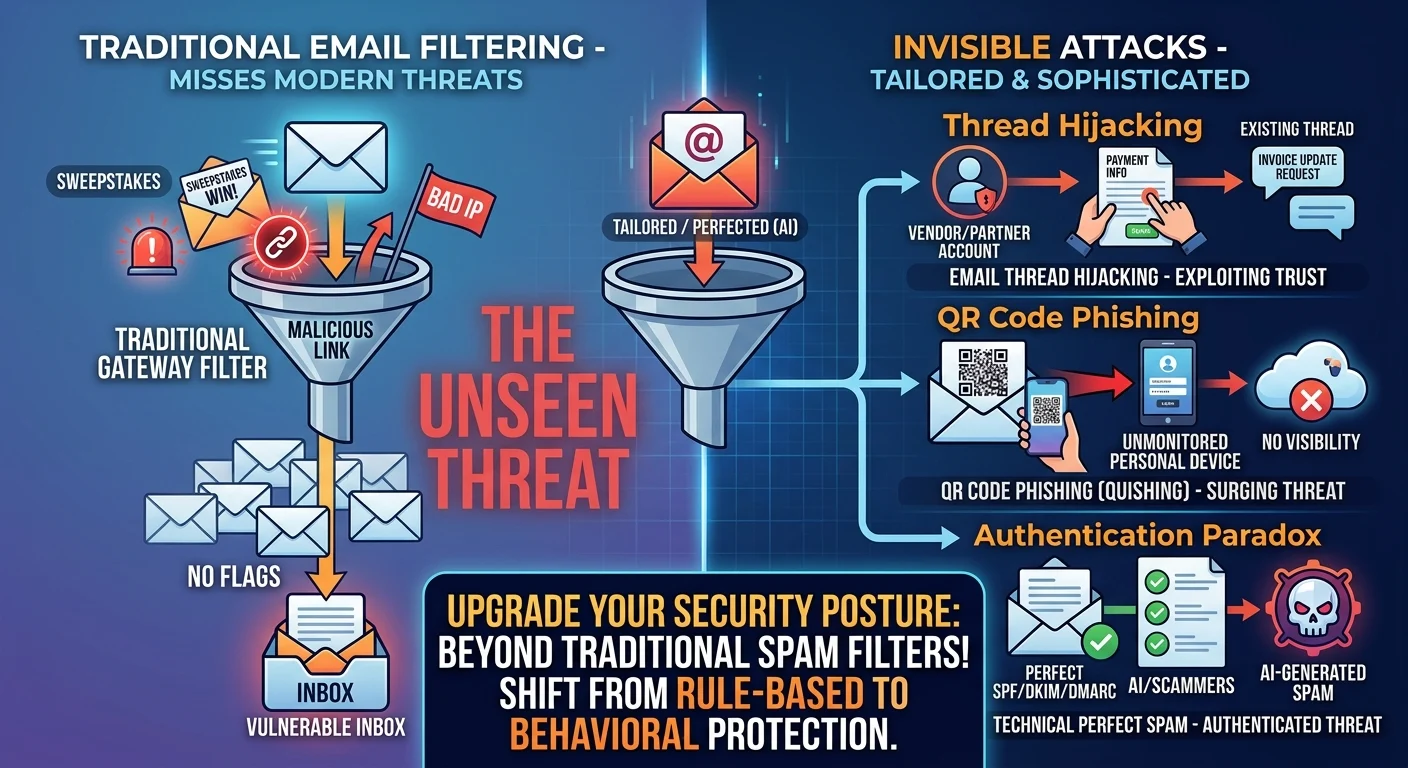
Traditional email security is built on a simple premise. It looks for known bad things. It scans for blacklisted IP addresses, malicious links, suspicious attachments, and specific spammy keywords. If an email doesn’t contain any of these red flags, the filter lets it pass.
Here’s the thing. Modern cybercriminals don’t use obvious red flags anymore. Instead, they leverage advanced artificial intelligence and psychological manipulation to create emails that look identical to legitimate communication. Because these messages lack traditional malicious markers, your security gateway waves them right through to the inbox.
How Thread Hijacking Proves Your Anti-Spam Filter Is Missing This Massive Threat
One of the most dangerous developments is email thread hijacking. In this scenario, an attacker doesn’t just send a cold email. They compromise a legitimate email account belonging to one of your vendors, clients, or partners. Once inside, they search for active, ongoing conversations about invoices, contracts, or wire transfers.
The attacker then inserts themselves into the existing thread. Because they are replying to a real conversation from a trusted email address, there is no suspicious link or attachment to flag. They simply ask to update the payment details for an upcoming invoice. To the recipient, it looks like a natural continuation of their daily workflow.
The QR Code Phishing Explosion
Another massive blind spot is the sudden surge in QR code phishing, often called quishing. Recent cybersecurity data shows that QR code phishing has more than doubled, with millions of these attacks bypassing corporate filters every month. But why are they so effective?
The answer is simple. Traditional email filters scan text and links. They do not look inside images. When an attacker embeds a malicious link inside a QR code, the filter sees nothing but a standard image file and delivers the email. The victim is then prompted to scan the code with their personal smartphone.
Now, this is where it matters. The moment the user scans that code, the attack moves from your secure, monitored corporate laptop to an unmanaged personal mobile device. Your security stack has no visibility into what happens next, allowing the attacker to easily harvest login credentials.
The Email Authentication Paradox
You might think that strict email authentication standards would solve this problem. Recently, major email providers like Google and Microsoft began aggressively rejecting emails that fail basic security protocols like SPF, DKIM, and DMARC. If a sender’s authentication is broken, their email is bounced before it even reaches the spam folder.
This has created a bizarre paradox. While these rules successfully block poorly configured, legitimate business emails, sophisticated scammers are easily adapting. Attackers simply set up brand-new, technically perfect domains that pass all authentication checks with flying colors. Because their infrastructure is flawless, their highly personalized, AI-generated spam is delivered straight to the primary inbox.
So what does that mean for you? It means relying on standard authentication checks is no longer enough to guarantee safety. The spam filters of yesterday are fundamentally unequipped to handle threats that are technically perfect but behaviorally malicious.
How to Protect Your Business From Invisible Threats
To defend against these sophisticated tactics, organizations must shift their approach. You can no longer rely on simple rules to detect bad emails. Instead, you need security tools that understand context, behavior, and intent.
Here are the steps you should take to upgrade your email security posture:
- Implement Behavioral AI: Upgrade to an email security solution that analyzes communication patterns. These systems establish a baseline of normal behavior and flag anomalies, such as a vendor suddenly changing their banking details or emailing at unusual hours.
- Deploy Image and QR Code Analysis: Ensure your security stack includes computer vision technology. Your filters must be able to extract and analyze URLs hidden inside QR codes, whether they are embedded in the email body or hidden inside PDF attachments.
- Enforce Out-of-Band Verification: Establish a strict internal policy for financial transactions. Any request to change payment information or initiate a wire transfer must be verified through a secondary channel, such as a phone call to a known number, regardless of how legitimate the email looks.
- Train Employees on Modern Tactics: Traditional phishing training often focuses on looking for spelling errors or mismatched sender domains. Update your training programs to educate employees on the dangers of thread hijacking and QR code scans.
The threat landscape has evolved far beyond the capabilities of the average spam filter. If you haven’t reviewed your email security strategy recently, it is highly likely that your organization is exposed. For more tips on keeping your digital environment secure, see our guide on [cybersecurity best practices].
Do not wait for a costly breach to reveal the gaps in your defenses. Take the time to evaluate your current tools and ensure you are prepared for the invisible threats of today.