(302) 262 8484
Your AI Apps Have a Massive Security Leak. Here is How to Fix It

If you are building, deploying, or even just using generative AI tools in your business, you need to pause and look under the hood right now. Your AI apps have a massive security leak, and the traditional firewalls you rely on are completely useless against it. We are not just talking about a minor bug in your code. We are talking about a fundamental shift in how applications are breached, and most teams are completely unprepared.
Why Your AI Apps Have a Massive Security Leak
Traditional security is built around controlling the pipe. You block unauthorized IPs, patch known SQL injection vulnerabilities, and encrypt your databases. But AI applications do not behave like traditional software. They reason, they process natural language, and they make autonomous decisions. That very intelligence is exactly what hackers are exploiting.
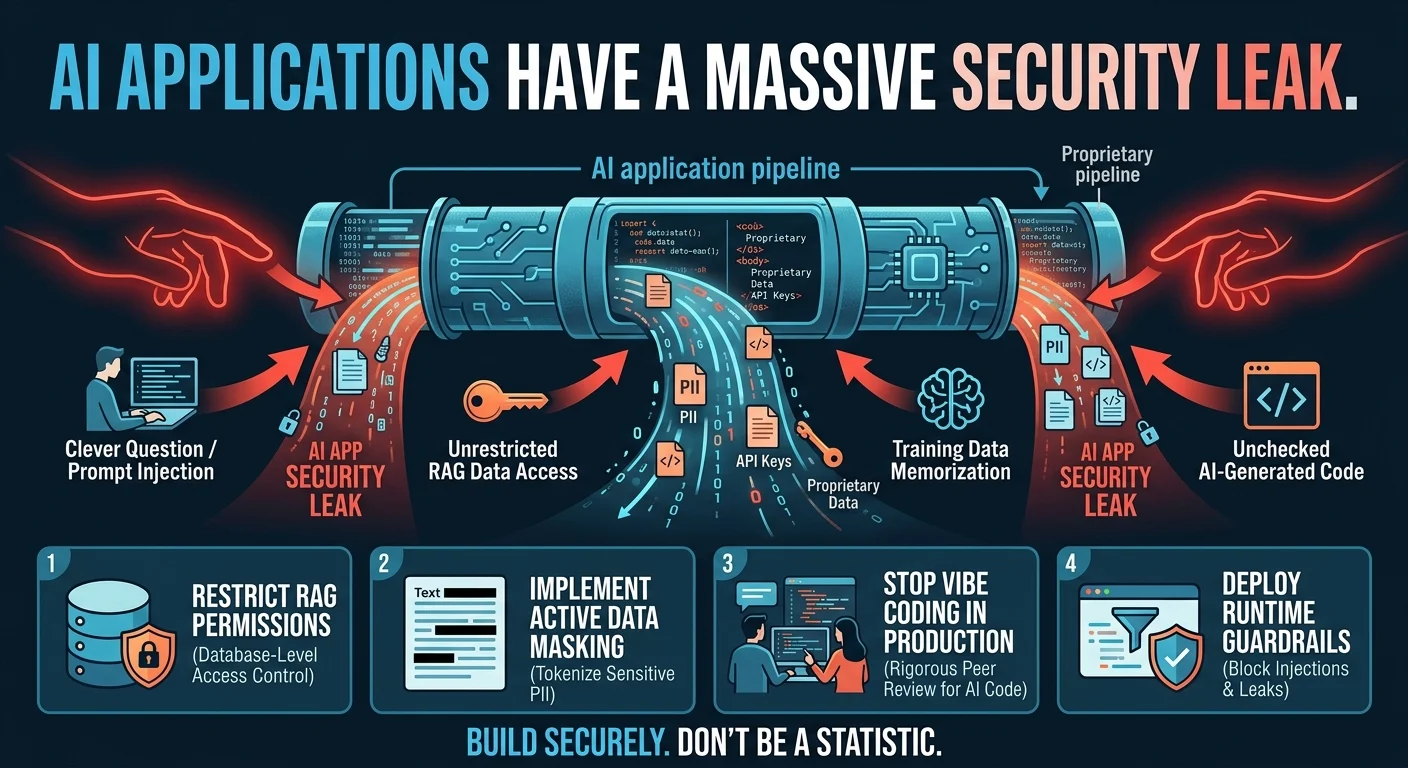
An AI security leak does not happen because someone broke through your network firewall. It happens because a user asked your chatbot a clever question, and the chatbot willingly handed over proprietary company data. When you plug an LLM into your internal databases, emails, and CRMs, you create a single, highly vulnerable point of access.
To understand how your data is slipping through the cracks, look at the three primary exposure points of an AI application:
- User input: Employees pasting proprietary code or customer PII into public chatbots without governance.
- Model training: Sensitive data being memorized and later reproduced in outputs to unauthorized users.
- Retrieval pipelines: AI agents accessing internal data stores without proper permission checks.
The Rise of Vibe Coding and the AI App Security Leak
Here’s the thing: the rush to ship AI features has created a massive quality control crisis. Developers have fully embraced “vibe coding”. Coined by Andrej Karpathy, vibe coding describes writing software by explaining what you want in natural language and letting tools like Cursor, Claude, or GitHub Copilot do the rest. It is incredibly fast, but it is incredibly messy.
A recent industry report from Checkmarx revealed that 70% of developers admit AI code generation tools introduced vulnerabilities into their code. Even worse, 93% of enterprises suffered a security breach due to in-house developed applications. When developers accept AI-generated code without a thorough manual audit, they are essentially shipping pre-packaged security flaws straight to production.
Prompt Injection is No Longer a Chatbot Trick
In the early days of generative AI, prompt injection was mostly a joke. Users would trick a chatbot into writing a pirate poem or revealing its system instructions. Today, it is a high-severity threat vector.
Consider the EchoLeak vulnerability discovered in Microsoft 365 Copilot, or the critical CVE-2025-53773 vulnerability in GitHub Copilot. These flaws proved that zero-click prompt injections can silently exfiltrate enterprise data and execute remote code. When AI agents are granted access to full systems to take action on your behalf, a single malicious prompt can compromise your entire network.
The Real-World Cost of an AI Security Leak
The threat is not theoretical. The latest Verizon Data Breach Investigations Report highlights a terrifying milestone: for the first time in nearly two decades, exploiting software vulnerabilities has surpassed stolen credentials as the number one entry point for cyberattacks. Why? Because hackers are using their own AI tools to scan and exploit code flaws in hours rather than weeks.
If your application has a vulnerability, attackers will find it before your team even gets around to reviewing the backlog. If you want to dive deeper into securing your pipelines, see our guide on [secure AI development practices].
Four Critical Steps to Fix Your AI App Security Leak
So what does that mean for you? You cannot protect an AI application using yesterday’s playbook. You have to secure the data, the model, and the code generator. Here is how you plug the leak before it ruins your business.
1. Restrict RAG and Vector Database Permissions
Retrieval-Augmented Generation (RAG) is how most companies connect their LLMs to internal data. However, if your vector database does not respect user permissions, you have a major security leak. An entry-level employee should not be able to ask the AI about executive salaries and get an answer. Enforce strict, role-based access control at the database layer, not just at the UI level.
2. Implement Active Data Masking
Never feed raw personally identifiable information (PII) or sensitive proprietary data directly to a third-party LLM. Use an active data masking layer that intercepts user prompts, replaces sensitive names, credit cards, or API keys with random tokens, and only de-tokenizes them on the way back to the user. The model can still reason over the structure of the data without ever seeing the sensitive details.
3. Stop Vibe Coding in Production
AI coding assistants are brilliant for prototyping, but they are not security experts. Every single line of AI-generated code must go through a rigorous peer review process. Do not let your developers accept code blindly just because it works. If you do, you are essentially letting an unvetted intern write your authentication flows.
4. Deploy Runtime Guardrails
You need an active guardrail system that monitors both incoming prompts and outgoing model responses. These guardrails act as a real-time filter, blocking known prompt injection patterns and preventing the model from outputting sensitive data if a leak does occur.
The Bottom Line on AI App Security
AI is moving faster than security teams can keep up, and the gap between deployment and defense is widening. Building fast is great, but building securely is what keeps you in business. Take the time to audit your AI pipelines today, because the hackers are already auditing them for you.