(302) 262 8484
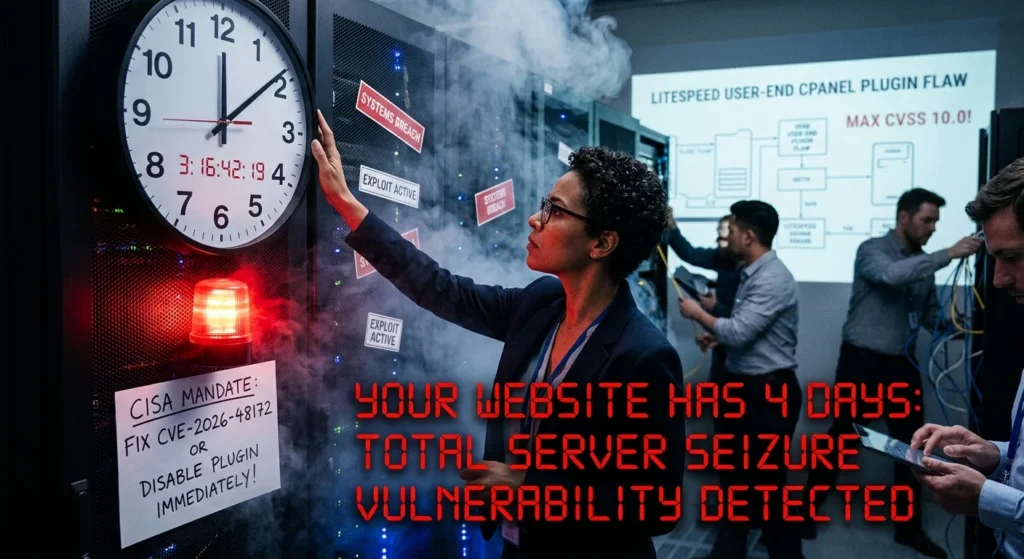
Your Website Has 4 Days To Fix This Critical Flaw

If you host your business online, you need to check your server configuration immediately. A massive security emergency is unfolding, and the Cybersecurity and Infrastructure Security Agency (CISA) has just issued a rare, ultra-tight deadline. In short, your website has 4 days to fix this critical flaw before attackers can potentially seize total control of your server. The vulnerability, tracked as CVE-2026-48172, targets a widely used server plugin, and hackers are already actively exploiting it in the wild.
What is CVE-2026-48172 and Why Is It a Nightmare?
The threat is centered around a critical privilege escalation vulnerability in the LiteSpeed User-End cPanel Plugin. Carrying a maximum-severity CVSS score of 10.0, this flaw allows low-privileged users on a shared server to execute arbitrary scripts with root privileges. In plain English, if you are on a shared server, a single compromised account next door is all it takes for an attacker to gain absolute control over the entire machine.
Here’s the thing. Many small and mid-sized businesses rely on shared hosting because it is cost-effective, but they often lack the necessary Small Business IT Consultation to navigate these risks. But this specific flaw turns that shared environment into a massive security hazard. Because the vulnerability lies within the plugin’s lsws.redisAble function, an attacker does not even need to compromise your specific account to get to your data.
Your Website Has 4 Days To Fix This Critical Flaw: The CISA Mandate
On May 26, 2026, CISA added this vulnerability to its Known Exploited Vulnerabilities catalog. The agency gave federal civilian agencies until May 29 to patch or completely disable the plugin. While this four-day directive technically applies to government systems, it serves as a massive wake-up call for the rest of the web.
So what does that mean for you? If your hosting provider has not updated their systems yet, your data is sitting in an unlocked room. Security experts have already observed attackers leveraging this zero-day to drop malware, steal credentials, and deploy ransomware, which often requires professional Ransomware Removal in Delaware to resolve.
Why is Your Website Vulnerable to This Critical Flaw?
LiteSpeed has grown rapidly to become the third-largest web server software in the world. It is incredibly popular because it acts as a drop-in replacement for Apache, boosting website speeds with minimal configuration. This widespread adoption means it is the default engine for millions of cPanel-managed websites.
If you are using a standard managed host, you probably did not install this plugin yourself, which is why Ongoing Website Maintenance and Support in Delaware is so critical for your security. Your hosting provider did. That means you are entirely dependent on their technical team to apply the patch before hackers find their way in.
How to Protect Your Site Before the Clock Runs Out
Waiting around for your host to fix this is a terrible strategy. You need to take a proactive approach to verify your server’s security status immediately by utilizing Proactive IT Monitoring for Small Business to catch vulnerabilities early.
Here is a quick checklist of the exact steps you or your administrator should take today:
- Check your web server type: Log into your hosting dashboard or use an online tool to see if your site is running on LiteSpeed.
- Verify the plugin version: Ensure your host is running LiteSpeed User-End cPanel Plugin version 2.4.7 or higher. Anything between versions 2.3 and 2.4.4 is highly vulnerable.
- Run an IOC check: If you have command-line access, run a quick scan of your cPanel logs using
grep -rE 'cpanel_jsonapi_func=redisAble' /var/cpanel/logsto check for signs of active exploitation. - Ask your host directly: Send a support ticket asking if they have patched CVE-2026-48172 on your shared server.
What to Do If You Detect an Intrusion
Now, this is where it matters. If the log check returns any unfamiliar IP addresses attempting to access the Redis function, you must assume your server has been compromised.
Do not just apply the patch and hope for the best. You need to inspect your system logs, identify any unauthorized files or web shells, and potentially restore your site from a clean backup created before the exploit window opened.
‘On shared hosting, root on one server means every tenant on it is compromised. Patch now, run the IOC check, and if you get a hit, assume attacker persistence.’ – Itai Goldman, CTO at Miggo Security
The Bottom Line on Modern Web Security
The speed at which threat actors are weaponizing new vulnerabilities is terrifying. With the rise of advanced AI tools, the window between a bug being disclosed and actively exploited has shrunk from weeks to mere hours.
You cannot afford to treat website security as a passive, set-it-and-forget-it task. Take five minutes right now to contact your hosting provider and ensure your server is fully patched. Your business’s digital home depends on it.