(302) 262 8484
Waze vs Google Maps: The Brutal Truth Nobody Tells You

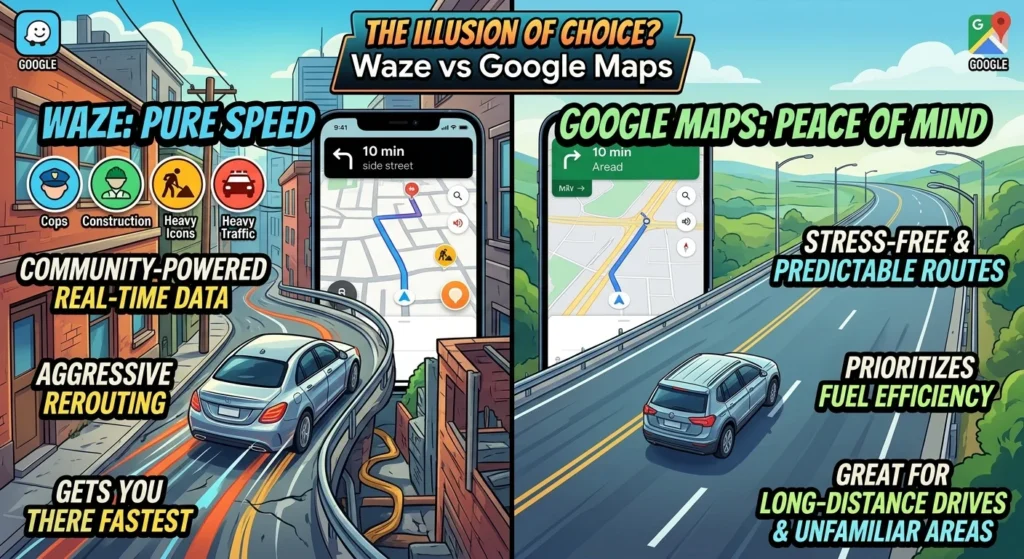
The Illusion of Choice: The Secret Behind Waze vs Google Maps
You are sitting at a red light, staring at your dashboard, trying to decide which app to launch. It’s the classic battle of Waze vs Google Maps. Most people think they are choosing between two fierce competitors, but here is the brutal truth: you are actually choosing between two different personalities owned by the exact same parent company. Yes, Google owns both, but they have kept them separate for a reason.
While Google Maps now pulls some incident reports directly from the Waze community, the two apps still operate on entirely different route-planning philosophies. One is built for peace of mind, while the other is built for pure speed.
The Core Differences in Routing Philosophy
The biggest difference between these two apps is not the interface. It is how they calculate your route. When you plug in a destination, the underlying code makes very different choices about how to get you there.
Waze vs Google Maps: How the Algorithms Think
Google Maps wants to give you a predictable, stress-free drive. It prioritizes fuel efficiency, main highways, and simple routes. It tries to avoid making you take three consecutive left turns across heavy traffic just to save forty seconds.
If you’re driving a long distance, planning a road trip with multiple stops, or navigating an unfamiliar city, Google Maps is almost always the superior choice. It keeps you on major roads where you feel safe and in control. If you are planning a longer journey, see our guide on [road trip planning] to make the most of your travel.
The Aggressive, Side-Street Explorer
Waze has one goal, and that is to get you to your destination as fast as humanly possible. It doesn’t care about your peace of mind. If saving two minutes means routing you through a quiet residential neighborhood, over three speed bumps, and onto a chaotic side street, Waze will do it without hesitation.
This aggressive rerouting is perfect if you are commuting in heavy traffic and already know the general area. Waze treats driving like a game, and the reward is beating the estimated time of arrival.
The Features That Set Them Apart
Beyond the routing algorithms, the two apps serve completely different lifestyles. Here is where the differences get highly practical.
Real-Time Alerts and Community Power
Waze is essentially a social network for drivers. Because users are highly active, you get instant alerts for speed traps, police presence, hazards, and road closures. While Google Maps has slowly adopted some of these reporting features, Waze is still much faster and more accurate at flagging active police stops.
Transit Modes and Offline Reliability
This is where Google Maps completely dominates. If you are walking, riding a bike, taking a subway, or catching a bus, Waze is useless, and you should rely on mobile repair services in Delaware if your device experiences any hardware issues during your commute. Waze is strictly for driving cars and motorcycles.
On top of that, Google Maps allows you to download entire regions for offline use. If you lose cell service in the mountains, you might also face challenges with your IT infrastructure for small businesses if you rely on cloud-based tools for your operations.tains, Google Maps keeps working. Waze, on the other hand, requires a constant, active data connection. Lose your signal, and Waze loses its mind.
The Verdict: When to Use Which App
So, which one should you keep on your home screen? It depends entirely on your situation.
Here is a quick breakdown to help you decide:
- Use Google Maps if: You are traveling long distances, need offline navigation, want to find local businesses, or rely on walking, biking, and public transit.
- Use Waze if: You are commuting through familiar, high-traffic areas, want to avoid speeding tickets, and don’t mind taking creative backroad routes to save a few minutes.
At the end of the day, there is no single winner. Many drivers find that keeping both apps on their phone is the smartest move. Use Google Maps for discovery and predictability, and switch to Waze when you need to beat the clock.