(302) 262 8484
Stuck in 1996: Inside the Internet’s Most Famous Digital Time Capsule

The original promotional site for the 1996 movie Space Jam is a rare artifact of the early World Wide Web. While the modern internet relies heavily on standardized layouts and aggressive monetization, many businesses today require professional website redesign in Delaware to keep their digital presence current, yet this site remains almost exactly as Warner Bros. published it. It offers a direct look at the experimental design practices of the mid-nineties.
Why the 1996 Space Jam Website Matters Today
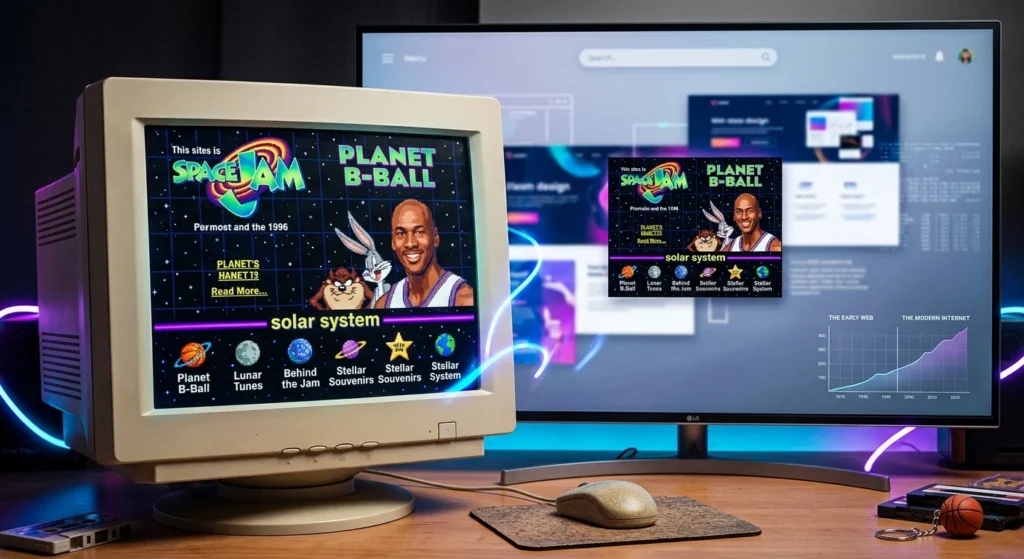
When Warner Bros. launched SpaceJam.com in 1996, movie websites were a new concept. A small team of developers was assigned to create a promotional space for the film starring Michael Jordan and Bugs Bunny, utilizing early forms of what we now consider comprehensive website solutions. The result was a defining example of mid-nineties web design, featuring a tiled starry background, neon text, and planetary navigation.
Most movie promotion sites from the nineties vanished within a year or two, turning into broken links or redirecting to corporate homepages. But the Space Jam site survived. It remained online, untouched by modern web standards. Today, it serves as a record of how the web functioned before social media, modern SEO and SEM in Delaware, and algorithmic feeds became standard.
Inside the 1996 Space Jam Website
Visiting the site today highlights the technical shifts of the past few decades. The page was designed for the low-resolution CRT monitors of the era. If you load it on a modern 4K monitor, the entire layout occupies a small square in the center of the screen.
The navigation is famously unconventional. Instead of a standard menu, users click through a solar system of planetary icons. The names of these sections are vague, requiring visitors to guess what they contain:
- Planet B-Ball: A collection of basketball-related trivia and movie tie-ins.
- Lunar Tunes: Behind-the-scenes information and audio clips of the film’s iconic soundtrack.
- Behind the Jam: Interviews, production notes, and credits for the film.
- Stellar Souvenirs: Desktop wallpapers, screen savers, and digital goodies you can download.
- Junior Jam: Coloring pages and interactive activities designed for kids.
The site even includes links to order the movie soundtrack on cassette tape, a clear marker of the physical media era.
The Secret Behind the Website’s Survival
The site survived for nearly three decades largely because it was forgotten. Warner Bros. IT staff likely left the server running because the entire project takes up only a few megabytes of space. Hosting such a lightweight site costs virtually nothing.
In the 2010s, internet users rediscovered the page. It quickly became a popular meme among web developers and a point of nostalgia for millennials. When Warner Bros. produced the sequel, Space Jam: A New Legacy, the studio needed the main domain for the new movie, but they knew deleting the original site would frustrate users.
They compromised by building the new site on the main domain while moving the 1996 version to its own directory. You can still access the complete original experience today by adding a simple folder to the web address, a stark contrast to the complex WordPress development in Delaware required for today’s dynamic sites.
Other Surviving Sites From the Nineties
While the Space Jam site is the most famous example, a few other historic pages have managed to stay online:
- The 1996 Dole/Kemp presidential campaign website, which remains online as a relic of early political campaigning.
- CNN’s comprehensive coverage page for the 1996 O.J. Simpson trial.
- The original CERN website from 1991, which was restored and put back online by historians.
If you love vintage tech, see our guide on [how the early internet shaped modern web design] to understand how these early layouts paved the way for the platforms we use today.
What the 1996 Web Can Teach Modern Designers
Reviewing these older sites offers practical context for modern web design. The creators of the early web worked with severe technical limitations, including slow dial-up speeds and primitive HTML. They had to prioritize efficiency alongside their creative choices.
Modern websites are often heavy and slow, despite our incredibly fast internet connections. The 1996 Space Jam site loads instantly because it relies on pure, lightweight HTML without heavy scripts or tracking pixels. It is a useful reminder of the value of keeping web design simple, fast, and, most importantly, fun.