(302) 262 8484
The Lazy Genius Behind the World’s First Webcam

Walking to the office breakroom only to find an empty, cold coffee pot is a familiar frustration. In 1991, a group of researchers at the University of Cambridge decided they had enough of this daily disappointment. They built the world’s first webcam to solve the problem.
How the First Webcam Saved Academics From Empty Coffee Pots
The project started in the Computer Laboratory at Cambridge, in a research space called the Trojan Room. About fifteen researchers shared a single drip coffee maker in a corridor outside the room. For the staff working on different floors, walking down multiple flights of stairs to find an empty pot was a waste of time.
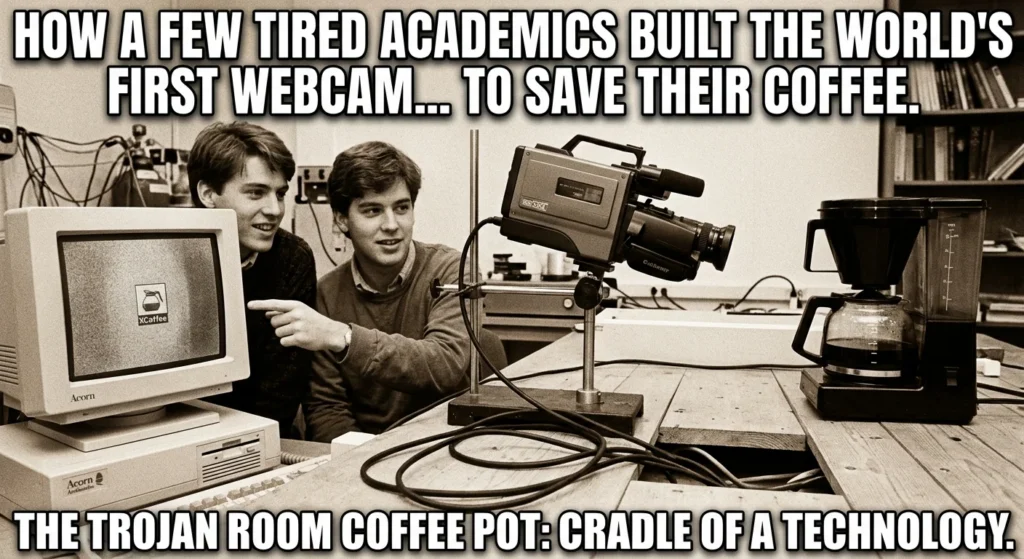
Researchers Quentin Stafford-Fraser and Paul Jardetzky devised a practical workaround. They rigged a camera to a retort stand and pointed it directly at the coffee machine. By running a cable under the floorboards to a video frame-grabber, they could capture the status of the pot in real time.
Building the First Webcam Software
Paul Jardetzky wrote a server program to capture a greyscale image of the pot every few seconds. Quentin Stafford-Fraser then wrote a client program called ‘XCoffee’, which ran in the corner of the users’ computer screens.
The system was basic. It updated just three times a minute and displayed a tiny, grainy icon. But as Stafford-Fraser later pointed out, the greyscale feed was adequate because the coffee itself was grey. This local setup saved the team countless fruitless trips to the corridor.
The Tech Stack Behind the First Webcam
The researchers built this system using spare parts they had lying around the lab:
- An old camera mounted on a retort stand
- A video frame-grabber card inside an Acorn Archimedes computer
- A custom server program to capture images every few seconds
- The XCoffee client software to display the feed on local screens
Taking the Trojan Room Coffee Pot Global
In November 1993, the World Wide Web was starting to gain traction. Fellow researchers Daniel Gordon and Martyn Johnson decided to connect the local camera system to the web. Once they did, anyone with an internet connection could see if these British computer scientists had coffee.
The feed attracted a massive audience. People from all over the world tuned in to watch a grainy, black-and-white image of a coffee pot in England. It was one of the earliest examples of using a network to view a physical space from miles away.
The Legacy of a Simple Coffee Hack
The Trojan Room coffee pot feed ran continuously for a decade. When the computer lab moved to new premises in August 2001, the camera was officially switched off. The final image captured was the fingers of the creators turning off the power.
Every time you join a Zoom call, check your home security camera, or watch a live stream, you are using technology born from academics trying to avoid an unnecessary walk. The invention of the webcam remains a clear example of how solving a mundane frustration can drive significant technological development.
If you want to read about more early internet history, check out our guide on [classic tech hacks].