(302) 262 8484
The Hidden Risks of Relying on USB Flash Drives for Office File Sharing

We have all seen it happen. Someone leans across the desk and tosses a plastic thumb drive to a coworker. Relying on USB flash drives for office file sharing might seem like a quick fix when a file is too large for an email. But it is actually a massive liability for your business.
Let’s be honest. Passing around a physical drive feels incredibly outdated. It is clunky and slow. Worst of all, it opens your entire network up to serious security threats.
Security Nightmares Waiting to Happen
Think about where that drive has been. Maybe it was plugged into a personal laptop at home. Maybe it spent a week rolling around the bottom of a gym bag. When someone plugs that exact same drive into your company network, they bypass your firewall completely.
Malware loves removable media. A single infected drive can take down an entire office network in minutes, which is why proactive IT monitoring for small business is essential for early threat detection.
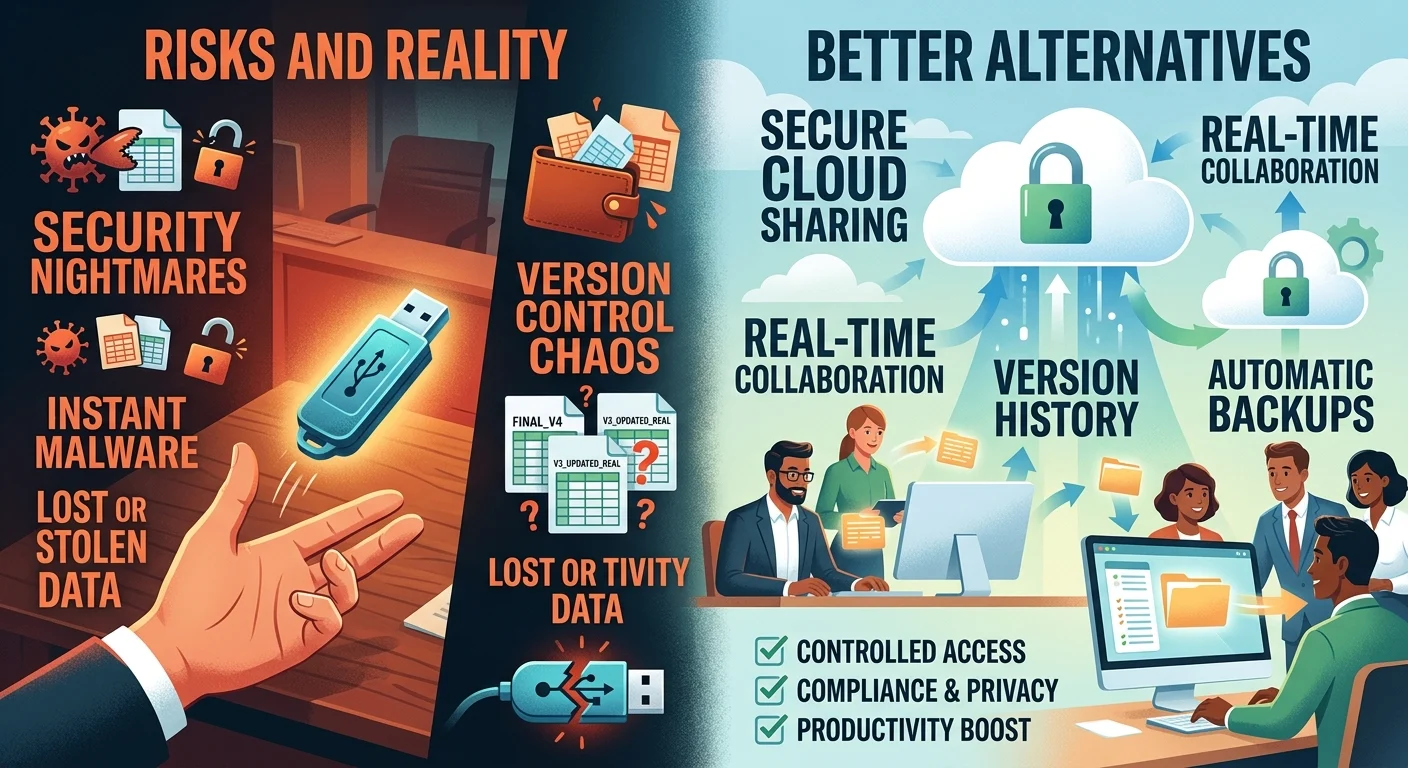
Here is what you are actually risking when you use USB drives for business data:
- Instant malware delivery: Viruses can auto-run the second the drive connects to a computer.
- Lost or stolen data: Thumb drives are tiny. They fall out of pockets and get left on coffee shop tables every single day.
- Lack of encryption: Most office workers buy cheap drives that offer zero password protection. If someone finds it, they can read everything on it.
Version Control Goes Out the Window
You probably know the drill. Someone edits a spreadsheet on the drive. Someone else copies it to their desktop, makes a few changes, and copies it back. Suddenly you have three different files.
Nobody knows if “Q3_Report_Final_V4_Real.xlsx” is actually the final version. People waste hours duplicating work or overwriting important updates. It is a completely avoidable mess that kills workplace productivity, often requiring professional Small Business Cybersecurity Protection to prevent further operational risks.
The Real Cost of Flash Drive Data Loss
These little plastic sticks are incredibly fragile. They get dropped in coffee cups. They get crushed under the wheels of office chairs. Sometimes they just corrupt for no obvious reason at all.
When that happens, the data is usually gone forever.
If that drive held your only copy of a major client presentation, you are in trouble. If it held sensitive customer information, you are looking at a much bigger problem.
Compliance and Privacy Failures
Losing a drive with unencrypted client data is a fast track to hefty fines. Most modern compliance frameworks require strict tracking of who accesses specific data and when they do it.
You simply cannot track access with a piece of hardware that fits in a pocket. If your business handles medical records, financial data, or personal customer details, a lost thumb drive is a literal disaster that highlights the need for robust IT infrastructure for small businesses.
A lost USB drive isn’t just an inconvenience. It is a potential data breach waiting to make headlines.
Better Alternatives for Secure File Sharing
So what should you do instead? The good news is that much better solutions exist today, and our team offers personalized IT solutions for small businesses to help you transition away from risky hardware.
Cloud storage platforms let multiple people edit a document at the exact same time. You get automatic backups, complete version history, and the peace of mind that comes with scalable IT services for small businesses.tory, and you never have to wonder who made the last edit.
For highly sensitive data, you should look into dedicated secure file transfer protocols. You can check out our guide on [secure cloud storage solutions for small businesses] to find the right fit for your team.
Time to Retire the Office Thumb Drive
Old habits are hard to break. The plug-and-play convenience of a flash drive is definitely tempting. But the risks heavily outweigh the benefits.
It only takes one lost drive or one nasty virus to cause a major business disruption.
Make the switch to secure cloud sharing. Ban the use of personal flash drives on company computers. Your IT team will thank you, and your data will actually stay safe.